

Who Owns Land in Space?: Rethinking the Ethics of Terraforming
MOTOMURA Yukiko
(Special Visiting Professor, Faculty of Life and Medical Sciences, Doshisha University; Guest Editor, The Mainichi Newspapers Co., Ltd.)
Space Development Through an Ethical Lens
Elon Musk, founder of SpaceX and a leading proponent of Mars colonization, has argued that humanity must become a "multi-planetary species." The idea is to prepare a "Plan B" planet in case Earth becomes uninhabitable. While such a vision may be technically feasible by fully deploying advanced technologies, and given sufficient funding and a willingness to accept certain sacrifices, should not those same resources be directed toward restoring Earth's environment? Is it ethically justifiable to prepare a "second Earth" while abandoning efforts to preserve the first?
Science and technology have undoubtedly advanced civilization. However, ethical judgments primarily rested on utilitarian principles—namely, the greatest good for the greatest number. Going forward, however, additional ethical frameworks must be considered for scientific and technological advancement.
The long-term impact of humans living in environments radically different from Earth remains unknown. Even highly trained astronauts experience bone and muscle loss, vision deterioration, and psychological stress in confined environments. While emergency return is possible from the International Space Station, orbiting 400 km above Earth, it would be virtually impossible from Mars, some 400 million km away. Even granting that Mars colonization is worthwhile, we must venture into modifying humans to adapt to the harsh environment of space. Through genome editing of embryos, we would create "post-humans" resistant to intense radiation, low gravity, and stress—and send them on a one-way ticket to Mars. By doing so, a new ethical issue is introduced: intervention in life itself. Having gained a "god's-eye view" through science and technology enabling surveying beyond the solar system, humanity ultimately comes to act as if it were divine. This is no longer an issue that can be addressed by utilitarianism alone.
Rethinking Our Relationship with Nature
Human progress has often been driven by aspiration—turning the impossible into the possible. This endeavor in itself is something noble. The successful Apollo program began with President John F. Kennedy's 1961 declaration that the United States would land a man on the Moon and return him safely within a decade. Such bold and seemingly unrealistic goals have since been referred to as "moonshots."
In 2000, President Bill Clinton proposed fitting the entire collection of the Library of Congress into a device the size of a sugar cube, spurring advances in nanotechnology. The rapid progress of AI-powered humanoid robots (physical AI) has likewise been fueled by researchers' almost childlike dream of holding a soccer world cup played by humanoid robots by 2050.
At the same time, such approaches—driven by capital and momentum—are becoming increasingly difficult for the public to accept. A relevant question appears in the Survey on the Japanese National Character, conducted every five years by the Institute of Statistical Mathematics involving a survey population of several thousand people: What kind of relationship with nature is most conducive to human happiness? Of particular note is the shift in the proportion of respondents who believe that "humans must submit to nature," which became the most common response in the latest survey (2018). This view surpassed "humans must conquer nature" in 1973, and later overtook "humans must utilize nature" in 1993. The view that nature must be conquered peaked in 1968, coinciding with the period when Japan achieved rapid economic growth through the promotion of science and technology. Other opinion surveys likewise indicate that the Japanese public's sense of the omnipotence of—and trust in—science and technology has been on the decline since then.
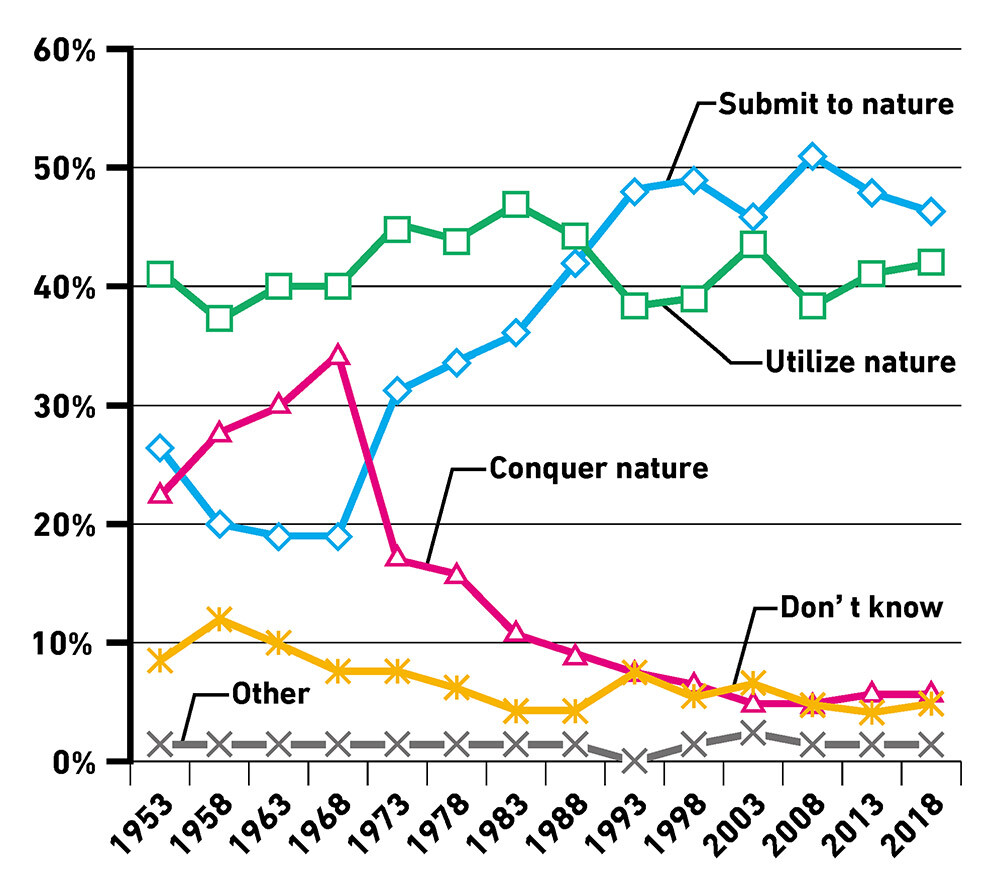
Source: Survey on the Japanese National Character, Institute of Statistical Mathematics

Wisdom for the Anthropocene
Many of the global challenges humanity faces today—global warming, nuclear proliferation, poverty and displacement driven by climate change, the proliferation of AI-generated misinformation and the resulting social divisions, and cyberattacks—have been brought about by rapid technological advancement and the excesses of capitalism. Humanity now finds itself struggling to manage the consequences of its own actions. It has also become increasingly clear that even with advanced technology, we are not fully capable of controlling natural disasters.
There is a growing argument that the present age in the geological time scale should be termed the "Anthropocene"—an era in which human activity leaves detectable traces in the geological record, from nuclear fallout to fossil-fuel soot and microplastics.
Humanity, which appeared only at the very end of Earth's "calendar year," has appropriated and exhausted the planet, and now contemplates expanding to and reshaping other planets as its next place of habitation. The meaning of these actions must be reconsidered from perspectives beyond mere technical feasibility.
The more we reflect, the more we recognize how our existence depends on a convergence of extraordinary contingencies—and how precious it is to sustain our Earth. Examining the grand vision of terraforming other planets holds worth precisely in that context.
- The first page
- Previous page
- page 1
- Current page: page 2
- 2 / 2
MOTOMURA Yukiko
(Special Visiting Professor, Faculty of Life and Medical Sciences, Doshisha University; Guest Editor, The Mainichi Newspapers Co., Ltd.)
Born in 1966. Graduated from the School of Education, Kyushu University. Formerly Director of the Science and Environment Department and Deputy Editorial Board Chair at The Mainichi Newspapers. She serves as Chair of the Screening Committee for the Science Journalist Awards and served as a member of the Selection Committee for the Space Development and Utilization Award sponsored by the Cabinet Office of Japan. She is the author of A User's Guide to Science (Kagaku no torisetsu), Strengthening Your Scientific Thinking! (Kagaku-ryoku o tsuyoku suru!), and The Science White Paper: The People Who Quietly Support This Nation (Rikei hakusho: kono kuni o shizuka ni sasaeru hitotachi), among other works.
The issue this article appears
No.65 "Earth"
The earth nurtures life and sustains the rich natural environments that surround us. We live each day benefiting from its blessings. How did the earth come into being? And is there land on planets beyond Earth?
This issue explores the diverse and colorful landscapes found around the world and the ways in which they are intertwined with people’s lives. We also trace the geological processes that have shaped these distinctive landscapes. In the Obayashi Project, we took on the ambitious challenge of conceptualizing the creation of habitable terrain and the development of an environment capable of sustaining life inside a Martian crater.
We reflect on the richness and significance of the natural world nurtured by the earth and turn our thoughts to the future of our planet’s environment.
(Published in 2026)
-
The Colors and Expressions of the Earth
- View Detail
-
Earth's Soil and Planetary Soil
FUJII Kazumichi
(Unit Leader, Soil Homeostasis Research Unit, Fukushima Institute for Research, Education and Innovation) - View Detail
-
Who Owns Land in Space?: Rethinking the Ethics of Terraforming
MOTOMURA Yukiko
(Special Visiting Professor, Faculty of Life and Medical Sciences, Doshisha University; Guest Editor, The Mainichi Newspapers Co., Ltd.) - View Detail
-
Terraforming: Ecosynthesis and Ecological Restoration on Mars
Christopher P. McKay
(Planetary Scientist; Senior Scientist, NASA Ames Research Center) - View Detail
-
OBAYASHI PROJECT
Creating Habitable Terrain on Mars: Crater Paraterraforming
Concept: Obayashi Project Team
- View Detail
-
Dreams of the Red Earth: Five Hundred Years of Martian Settlement
TAKEUCHI Kaoru
(Science Writer; Professor, Faculty of Social Informatics, ZEN University) - View Detail
-
The "Earthen Houses" of Iceland
FUJIMORI Terunobu
(Architectural historian and architect; Director, Tokyo Metropolitan Edo-Tokyo Museum; and Emeritus Professor, University of Tokyo) - View Detail
-
The Earth's Memory: Landscapes Shaped by Nature and Human Life
- View Detail