

Dreams of the Red Earth: Five Hundred Years of Martian Settlement
TAKEUCHI Kaoru
(Science Writer; Professor, Faculty of Social Informatics, ZEN University)
It is often said that eight out of ten predictions about the future prove wrong. By the same token, two may come true. The fate of human civilization on Mars may still belong to the realm of science fiction. Even so, I find myself imagining what it might look like a hundred, even five hundred years from now, in the hope that some part of this vision may fall within that 20 %.
Terraforming in Progress: Subterranean Cities and Another Sky
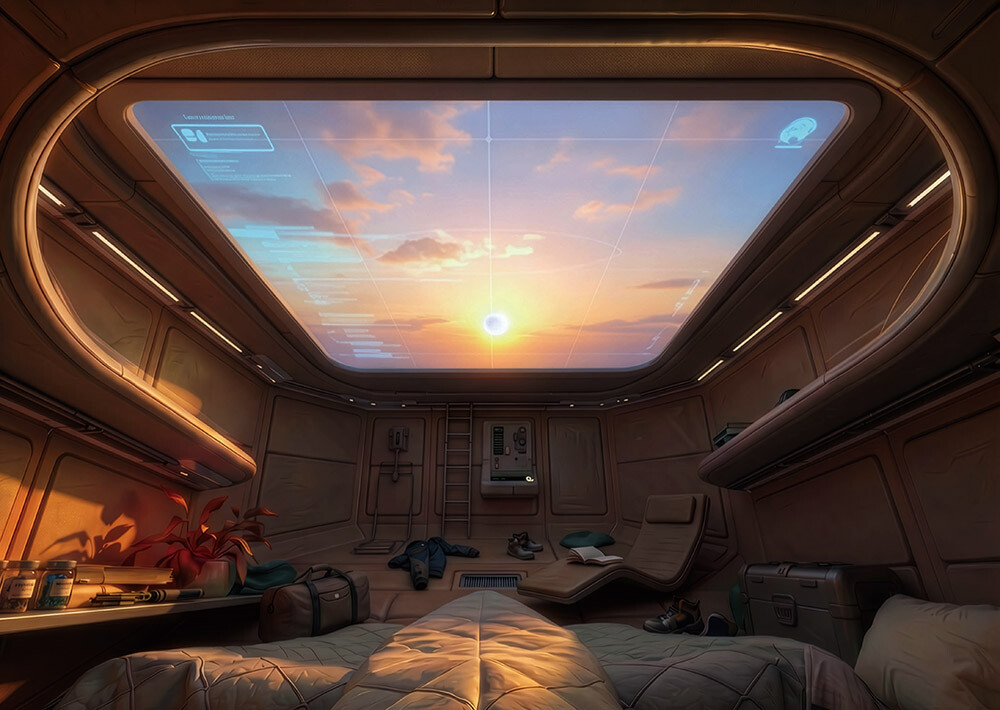
It's six in the morning. In the underground city of Arkesia, the lighting shifts gradually from amber to white. 10-year-old Meenya wakes, gazing up at a holographic sky projected across the ceiling, modeled on Earth's. Having never seen a real sky, she knows it only as a landscape from stories.
Her father, who works on the surface, is checking the forecast for red dust storms, as he does every day. Her mother heads to the agricultural zone below ground, where lettuce grown under LED light is slightly smaller than its terrestrial counterpart. Down the corridor, children bounce lightly toward school, delighting in the weak gravity.
Here, the underground is everyday life. This artificial sky is their "outdoors."
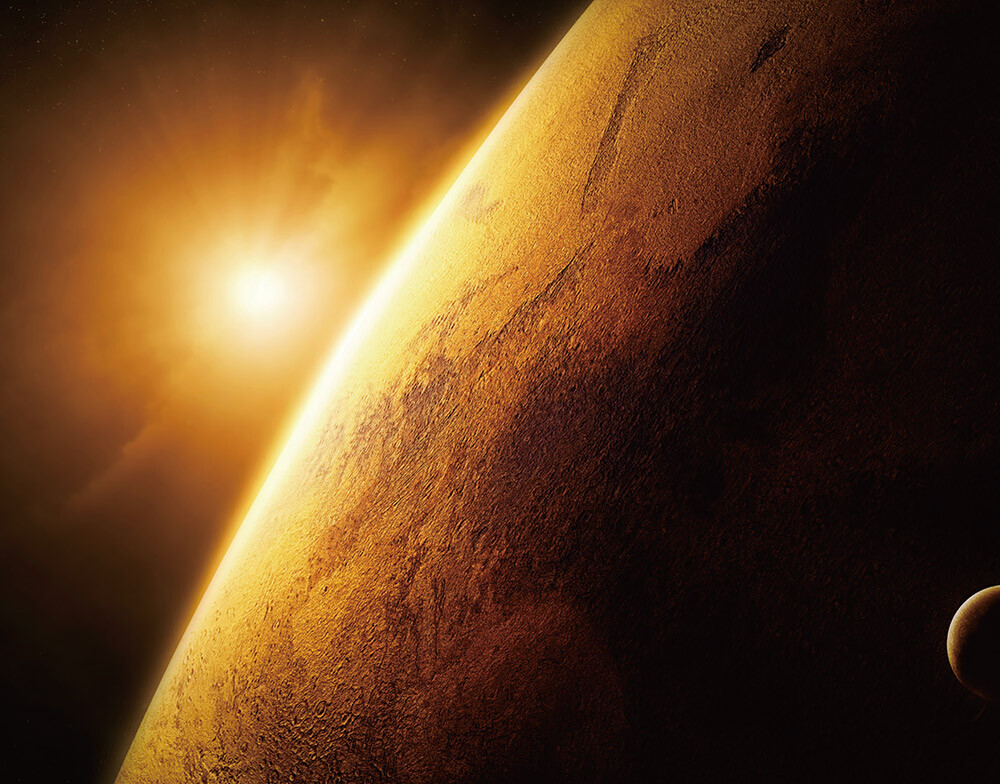
Mars is beautiful, yet arid. The sky is red, and the atmosphere is thin—its pressure only about 1 % of Earth's, composed mostly of carbon dioxide. Its gravity is roughly 38% of Earth's, and with no planetary magnetic field like ours and only a thin atmosphere, intense radiation pours onto the surface.
Even with terraforming underway, creating a human-friendly environment will take an unimaginably long time.
Where, then, do people live in the meantime?
One answer lies beneath the surface.
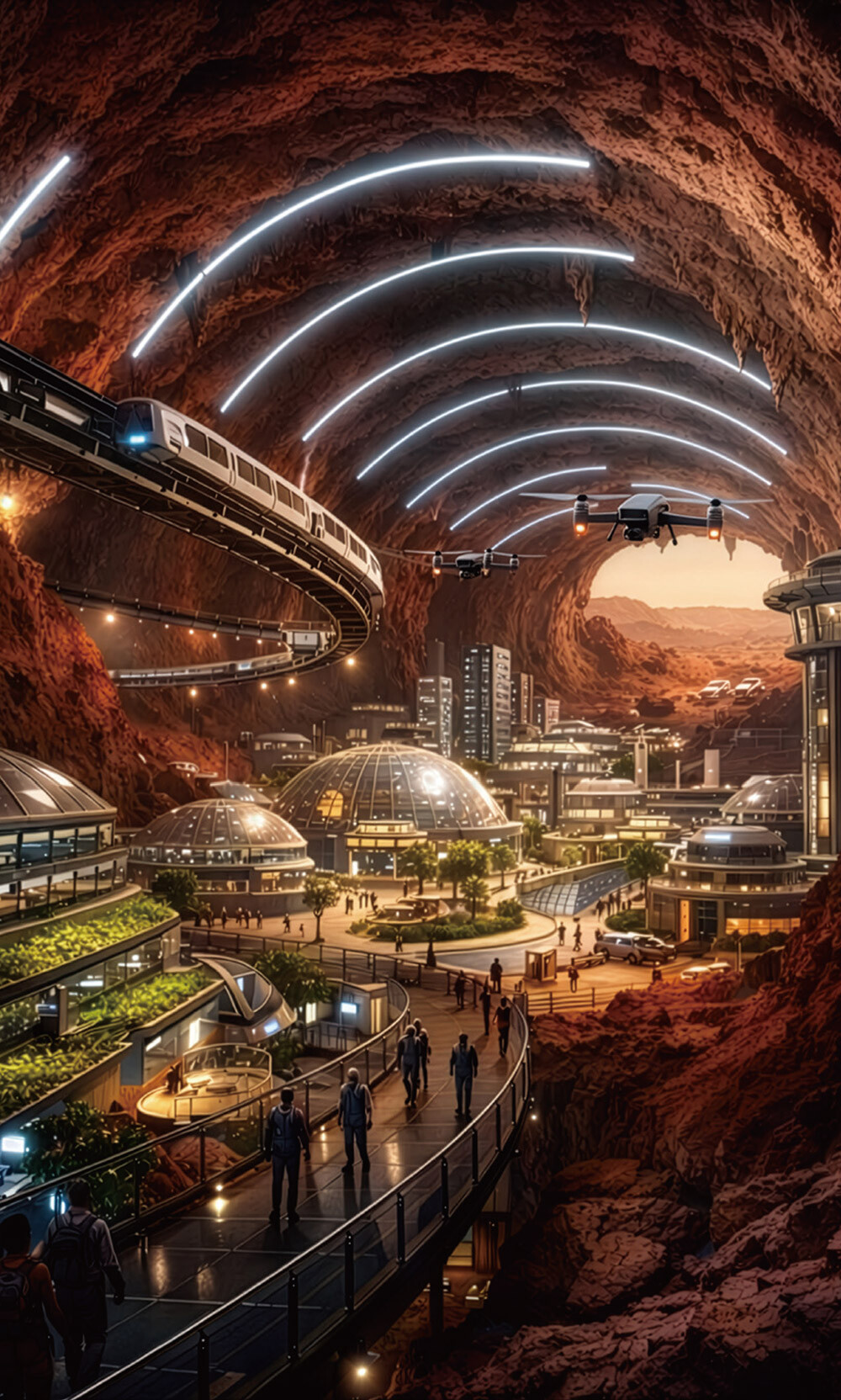
Mars is believed to contain vast subsurface cavities known as lava tubes—tunnel-like voids formed by ancient volcanic activity. Shielded by thick rock, they offer protection from radiation and meteorites. Humanity would transform these naturally formed spaces into comfortable homes.
The idea of an underground city may suggest confinement, yet such cities would encompass far more than housing: schools, hospitals, farms, laboratories, public squares, and commercial areas including shopping malls. Water would be extracted from subsurface ice, and plants grown under artificial light. Air and water circulate, allowing the city to function like a single living organism.
Transport will also change. Cities will be linked by airtight tunnels, where electric vehicles and autonomous systems move quietly back and forth. Of course, special equipment is required to go out onto the surface, where there is no oxygen and only a thin carbon dioxide atmosphere, but underground, people are able to carry on with their daily lives.
What is truly challenged in building these cities is not merely architectural capability, but the perspective of how to design environments in which people can live in secure and reliable conditions across generations within limited resources. Systems built to last, and spaces that sustain psychological well-being, become essential under such extreme conditions.
On Earth, cities have spread beneath the open sky. On Mars, however, another sky must be created beneath the land's surface. Artificial light marks the morning, and stable pressure envelops daily life. Rather than forcing nature to change, people build their way of living by accepting its conditions as they are.
These underground cities will serve not only as footholds for future space development, but also as experimental grounds for sustainable urbanism. The knowledge gained there will gradually feed back into city-building efforts on Earth. To reiterate, building a city on Mars is to do more than construct buildings.
It is to demonstrate that humanity can sustain a way of life under any conditions—a profound and far-reaching challenge.
The First Settlers, and Mars 100 Years Later, 500 Years Later
It's the year 12 of the Martian calendar. Dr. Tanaka, one of the first settlers and a medical doctor, records a message on a terminal:
"Today, the first baby born on Mars took its first steps."
Across the low-gravity floor, the child moves slowly, as if through water. Each small step beats a rhythm shaped by a gravity different from Earth's.
By the time this child reaches adulthood, will Earth be regarded as a distant homeland?
The first to arrive on Mars will not be adventurers so much as specialists such as doctors, engineers, ecologists, AI researchers, and construction experts. They will be both dreamers and realists. They have to be prepared and fit to live cooperatively over long periods in a confined space.
For the first 100 years, the central concern will likely be survival. The population may range anywhere from several thousand to tens of thousands. Air, water, and food will be strictly managed; nothing can be wasted. Safety would often take precedence over freedom, and community over the individual. Education will focus on not only science and engineering, but also the ability to live together.
After 500 years, however, the landscape may be transformed. Generations born on Mars could develop bodies adapted to low gravity, or exhibit skeletal and muscular development differing from that of humans on Earth. As fewer people assume a return to Earth, a sense of identity as "Martians" may emerge naturally.
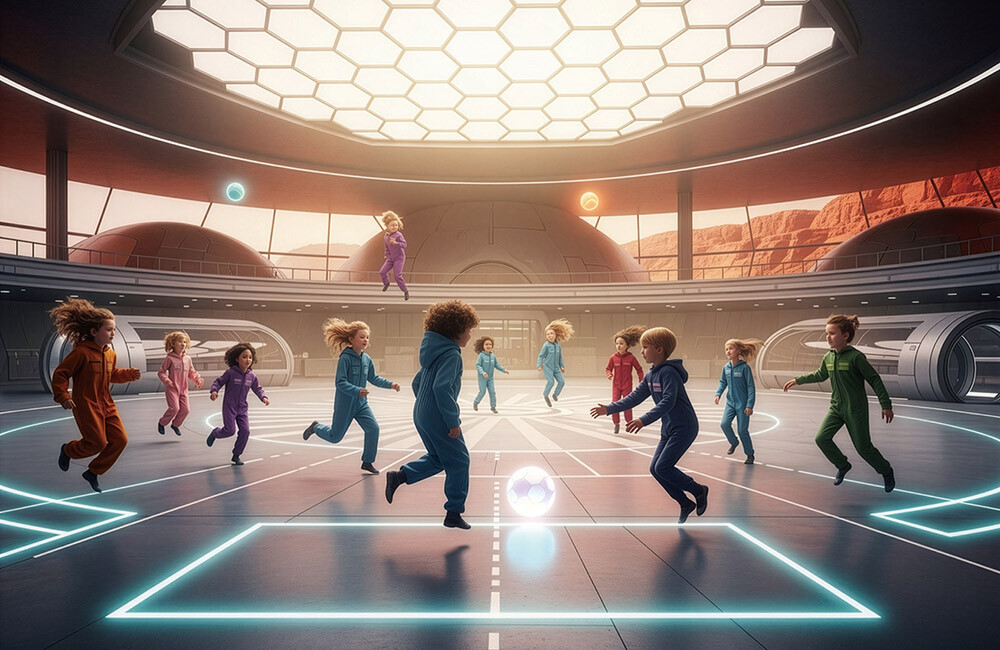
A Martian day is about 39 minutes longer than Earth's. This slight difference could shape distinct calendars and rhythms of life. New holidays and anniversaries unique to Mars would likely emerge. Sports and arts shaped by low gravity would also develop—three-dimensional dance or spatial competitions that would be unimaginable under Earth's stronger gravity, yet entirely possible on Mars.
What begins as an extension of societies on Earth will, over time, evolve into a culture of its own. Civilization changes, gradually, in response to its environment.
Relations with Earth: New Forms of Connection Shaped by Distance
In a communications room of an underground city, a young man named Ramon waits for a video message from his mother.
"How are you?"
On the screen, Earth appears blue, clouds drifting slowly. His reply takes a little over 10 minutes to arrive. Conversation resembles correspondence more than dialogue.
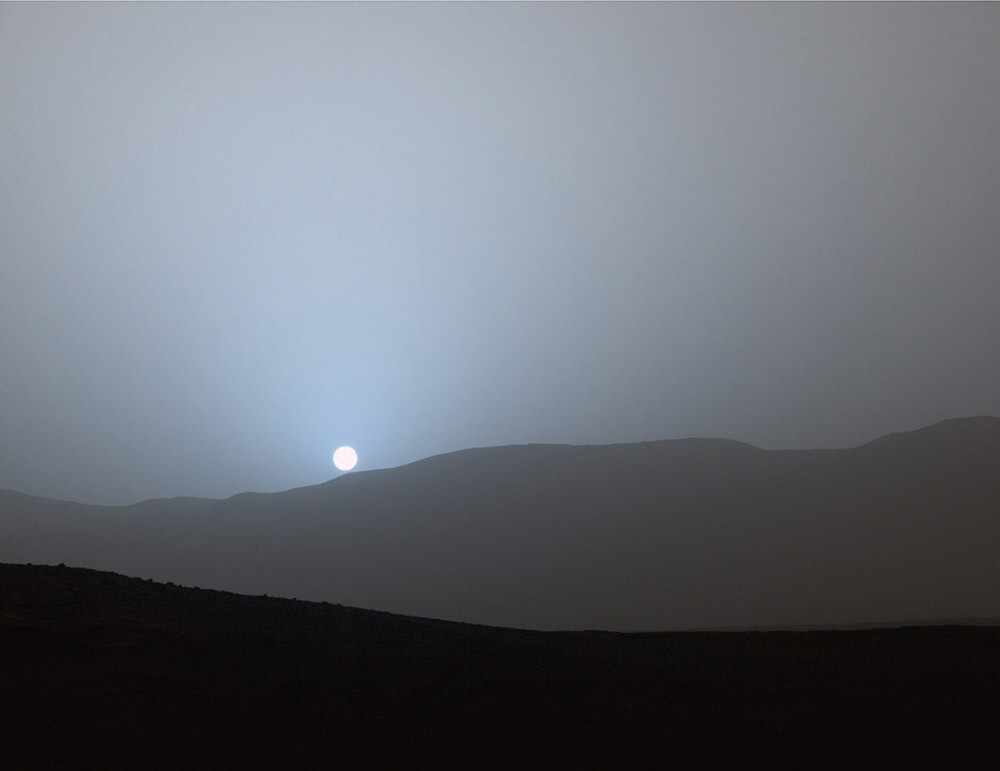
Still, each week he sends her photos of Martian sunsets—the blue sky, the pale sun. It is precisely because of the distance that each other's landscapes take on a special significance.
The distance between Mars and Earth means that communication takes anywhere from 3 to 22 minutes each way. While negligible in casual exchange, such delays carry weight in political and economic decision-making. Mars is likely to evolve into a society shaped by people who think and decide for themselves.
History suggests that societies established in distant lands have, over time, come to seek self-governance and independence. Whether Mars will follow the same path is uncertain. In its early stages, it will depend heavily on Earth for supplies and technology, making close cooperation essential.
At the same time, Mars may become a vital hub for resources and research. It also holds value as a base for water ice and mineral resources, as well as for asteroid exploration. Over the long term, it is possible that competition or even conflict could arise between Earth and Mars.
Yet in the vastness of space, it seems that cooperation is more rational than conflict. Earth, with its rich biodiversity and long history, serves as our home ground, while Mars serves as a stage for experimentation and challenge. If the two civilizations can build a relationship that complements one another, it will mark a new form of solidarity in human history.
Should Mars ever declare independence, it may signify not a rejection of Earth, but the birth of a second human civilization.
Distance, rather than creating division, may give rise to new forms of connection.
Language on Mars in the Age of AI
After school, children are playing in a "floating play area."
"It's 0.38 again!"
Someone calls out, and everyone laughs. Measured in Earth's terms of gravity, it's a number that doesn't quite register for humans on Earth, yet for them it's something their bodies instinctively recognize.
In the classroom, AI translation runs continuously. Japanese, Spanish, Hindi, and English blend in real time. Still, the children invent their own expressions.
"Red morning!"
A new greeting that emerged on Mars, signaling an approaching dust storm.
Language reflects its environment. On Mars, terms related to gravity, pressure, and radiation will enter everyday speech. Technical terms from Earth may become part of the common vocabulary. Also, differences in how time is perceived may reshape greetings and metaphors.
As languages intermingle, distinct Martian expressions and pronunciations may emerge. The more diverse the settlers' origins, the richer this linguistic evolution will be.
At the same time, in an age of highly advanced AI translation, language barriers are no longer as high as they once were. If everything can be translated in real time, will there still be a need to learn languages?
The answer is likely yes, as language is not merely a tool for conveying information but something that shapes the very way we perceive the world. The bodily sensibilities of those raised in low gravity will differ in noticeable ways from those on Earth. Those differences will, in time, find their way into poetry, storytelling, and emotional expression. A Martian language will carry its own sense of lived experience.
AI may facilitate understanding, but it cannot fully convey cultural depth. For that reason, language education will likely remain on Mars. Its purpose, however, may shift from practical use toward a deeper understanding of one another's worldviews and cultures.
Rooted in the Martian landscape, humanity will begin to weave its own stories.
Even under different gravity and thin air, people will continue to share their worlds through language. This very endeavor is a fundamental force sustaining human civilization.
- Current page: page 1
- 1 / 1
TAKEUCHI Kaoru
(Science Writer; Professor, Faculty of Social Informatics, ZEN University)
Born in 1960. Graduated from the College of Arts and Sciences and the School of Science at the University of Tokyo. He later completed the doctoral program at McGill University in Canada and earned a Ph.D. in Science. He is the author of The Frightening Side of Science: Stories That Will Keep You Awake at Night (Kowakute nemurenaku naru kagaku) and Hawking and the Universe of Imaginary Time (Hokingu kyojikan no uchu); co-author, with YAMAZAKI Naoko, of When Will We Go to Space? (Bokutachi wa itsu uchu ni ikeru no ka); and translator of The Universe in a Box: Simulations and the Quest to Code the Cosmos (Hako no naka no uchu: Atarashii uchu 138 oku nen no rekishi) and What Is Life? (Seimei to wa nani ka), among other works.
The issue this article appears

No.65 "Earth"
The earth nurtures life and sustains the rich natural environments that surround us. We live each day benefiting from its blessings. How did the earth come into being? And is there land on planets beyond Earth?
This issue explores the diverse and colorful landscapes found around the world and the ways in which they are intertwined with people’s lives. We also trace the geological processes that have shaped these distinctive landscapes. In the Obayashi Project, we took on the ambitious challenge of conceptualizing the creation of habitable terrain and the development of an environment capable of sustaining life inside a Martian crater.
We reflect on the richness and significance of the natural world nurtured by the earth and turn our thoughts to the future of our planet’s environment.
(Published in 2026)
-
The Colors and Expressions of the Earth
- View Detail
-
Earth's Soil and Planetary Soil
FUJII Kazumichi
(Unit Leader, Soil Homeostasis Research Unit, Fukushima Institute for Research, Education and Innovation) - View Detail
-
Who Owns Land in Space?: Rethinking the Ethics of Terraforming
MOTOMURA Yukiko
(Special Visiting Professor, Faculty of Life and Medical Sciences, Doshisha University; Guest Editor, The Mainichi Newspapers Co., Ltd.) - View Detail
-
Terraforming: Ecosynthesis and Ecological Restoration on Mars
Christopher P. McKay
(Planetary Scientist; Senior Scientist, NASA Ames Research Center) - View Detail
-
OBAYASHI PROJECT
Creating Habitable Terrain on Mars: Crater Paraterraforming
Concept: Obayashi Project Team
- View Detail
-
Dreams of the Red Earth: Five Hundred Years of Martian Settlement
TAKEUCHI Kaoru
(Science Writer; Professor, Faculty of Social Informatics, ZEN University) - View Detail
-
The "Earthen Houses" of Iceland
FUJIMORI Terunobu
(Architectural historian and architect; Director, Tokyo Metropolitan Edo-Tokyo Museum; and Emeritus Professor, University of Tokyo) - View Detail
-
The Earth's Memory: Landscapes Shaped by Nature and Human Life
- View Detail