

Who Owns Land in Space?: Rethinking the Ethics of Terraforming
MOTOMURA Yukiko
(Special Visiting Professor, Faculty of Life and Medical Sciences, Doshisha University; Guest Editor, The Mainichi Newspapers Co., Ltd.)
Earth Is Becoming Crowded
The surface area of the Earth is approximately 510 million km2. Most of it is ocean; land accounts for 29 %, or about 147 million km2.
To put this into more familiar terms, that equals roughly 14.7 billion ha. Dividing this by the global population—8.2 billion as of 2025—yields about 1.8 ha per person.
But how large is that, really? In simple terms, it corresponds to a square roughly 130 m on each side. I live in Kyoto, the site of Heian-kyo—the imperial capital of Japan from 794 to 1869—where a typical urban block was a square roughly 120 m on each side. It was later divided in half lengthwise by Toyotomi Hideyoshi—the 16th-century warlord who unified Japan—during his urban land reforms, and traces of that layout remain visible today, making the scale easy to visualize.
That may sound reasonably spacious. Yet this figure does not account for regions uninhabitable to humans, such as the Himalayas or the polar zones. Nor does it consider the land required to support everyday life, including land for agriculture, commerce, and public infrastructure.
Meanwhile, the global population continues to grow. A century ago, it stood at just 2 billion. The Earth will only become more crowded and increasingly difficult to live in. Throughout recorded history, a great many wars have been fought over land disputes that proved impossible to resolve. Conflicts over limited land and borders are likely to increase. Given these conditions, even outlandish ideas are beginning to emerge—such as leaving Earth altogether and settling on other planets in the solar system.
Mars as a "Second Earth"?
At hand is Obayashi Quarterly (Kikan Obayashi; Obayashi Corporation), No. 33, published in 1990, devoted to the theme of Mars.
A project team of Obayashi engineers examined the feasibility of large-scale migration to Mars from multiple practical perspectives, drawing on the latest available knowledge at the time.
Their scenario envisioned an internationally coordinated manned Mars mission beginning in 2011, involving the United States, the Soviet Union, Japan, China, and Europe, followed by the start of agriculture in 2020. By 2057, a child would be born on Mars—the first human to be born there. Abundant mineral resources would fuel the economy, triggering not a gold rush but, rather, a "platinum rush" that would attract migrants from Earth. Eventually, in 2101—corresponding to the 22nd century on Earth—a Martian Federation, led by those born on Mars, would achieve independence.
It is certainly interesting as a piece of reading, but what drew my attention even more was that this analysis was carried out before the events that would later shape the world after 1991: the collapse of the Soviet Union, the September 11 attacks, the global financial crisis, or, in Japan, the bursting of the economic bubble and the 2011 earthquake and tsunami. In this sense, this issue can be seen as a time capsule filled with the hopes of 1990.
Cosmic History and Humanity
The universe is believed to have originated 13.8 billion years ago in the Big Bang. Atoms—the building blocks of the material world—formed some 380,000 years later. It took another 400 million years for those atoms to coalesce into stars. After an even longer span, the solar system, including Earth, emerged around 4.6 billion years ago.
Life on Earth endured five mass extinction events, including those triggered by massive asteroid impacts, before the ancestors of humanity appeared. If Earth's 4.6-billion-year history were compressed into a single calendar year, humans would arrive late on New Year's Eve. Homo sapiens would emerge only as the New Year's Eve bells begin to ring.
That such latecomers have achieved this level of flourishing may well be considered extraordinary. Humans endured hunger and extremes of climate, protected themselves and their families from predators, and fought off enemies. In the intervals between such struggles, they looked to the sky, observed the movement of the stars, and imagined unknown worlds.
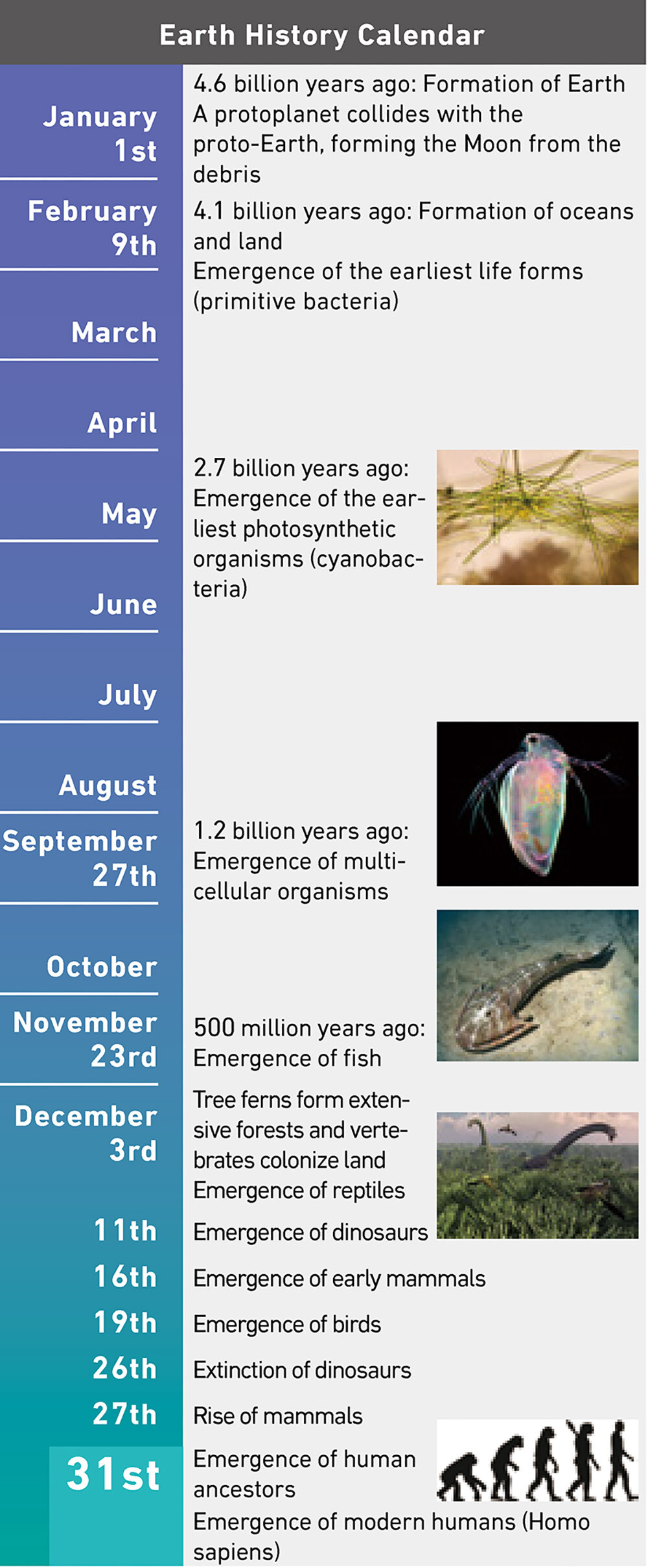
Fortuitously, humans possessed an imagination far richer than that of other animals. That imagination fostered curiosity, leading to the realization that the Earth is round—and that it is the Earth that moves.
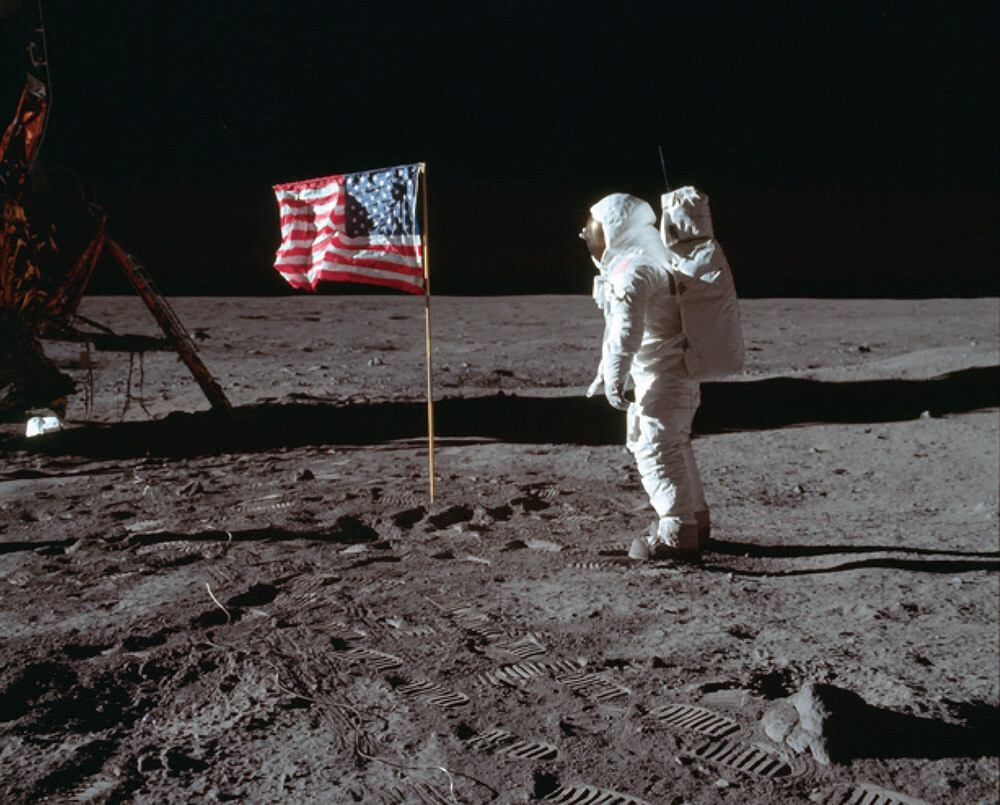
Eventually, people were no longer satisfied with imagination alone. By the 20th century, they began to aim for outer space. The first human Moon landing by Apollo 11 marked a milestone in that journey.
On July 20, 1969 (U.S. Eastern Time), commander Armstrong and astronaut Aldrin planted the American flag in the dusty lunar soil. It was not merely an expression of triumph—"we were the first to arrive"—but also a statement made on behalf of national prestige. As this episode suggests, space exploration has been inseparable from national interests.
Ambitions and Ownership
On Earth, there remains land that belongs to no one: Antarctica. The Antarctic Treaty of 1959, signed by 12 nations including Japan, restricts its use to peaceful purposes and scientific research, prohibiting territorial claims, military installations, nuclear testing, and the disposal of radioactive waste. Conversely, without such rules, conflict would be inevitable.
Outer space is likewise governed by the Outer Space Treaty of 1967, which prohibits national appropriation. However, while sovereignty over celestial bodies is forbidden, there remains interpretive room regarding their use—such as resource extraction.
This is where national interests come into play. Just looking at lunar exploration, Japan and the United States are advancing the Artemis program, aiming for a return to crewed lunar landings. China has successfully landed an unmanned probe on the far side of the Moon and, building on this achievement, is planning an independent crewed lunar base together with Russia. India has also successfully landed an unmanned probe near the Moon's south pole. Behind these efforts lie strategic ambitions with geopolitical overtones, including the desire to secure priority access to resources believed to lie beneath the lunar surface, as well as broader ambitions extending to Mars exploration and even military dominance.
One major reason that the terraforming of Mars envisioned by engineers has yet to be realized perhaps lies in these conflicting visions surrounding the use of space. Yet this delay may not be entirely unfortunate. What once seemed impossible when the concept was first conceived has now become ordinary 36 years later. Not only has computing advanced, but light emitting diodes (LEDs) that enable plant factories have become widespread, and waste recycling technologies along with highly efficient solar power generation have also made great progress.
Above all, the psychological distance to space has been reduced for people across society. Private companies now launch satellites almost daily somewhere on Earth. With sufficient means, even private individuals can stay aboard the International Space Station. In the 21st century, space—depending on how one defines its scope—has undoubtedly become within our reach. When astronauts are asked about the importance of crewed space development, they often liken human space exploration to the Age of Discovery between the 15th and 17th centuries, arguing that "humans are drawn to the unknown and they act on that aspiration. Reaching for space is no different." Yet drawing a direct parallel between the two may be problematic. Explorers such as Columbus and Magellan set sail in search of lands whose existence was uncertain. Today, the Moon and the planets of the solar system have been extensively studied. One might argue, somewhat cynically, that space exploration is now less about discovery than about confirmation.
Put that way, the romance disappears. Perhaps this is why we are now invoking a new rationale: "utilization." This includes extracting resources, meeting tourism demands, or even securing a refuge in case climate change or nuclear war renders Earth uninhabitable. In other words, we begin searching for reasons why we must go.
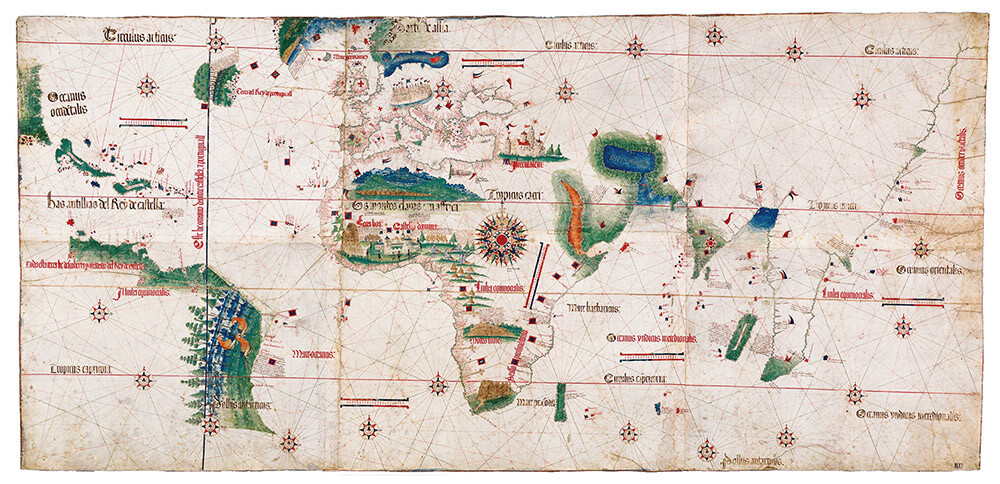
Following achievements such as Christopher COLUMBUS's arrival in the West Indies and Vasco da GAMA's opening of the sea route to India via the southern coast of Africa, regions including the Caribbean islands and the coastal areas of Africa were depicted in detail. © Aflo
- Current page: page 1
- page 2
- 1 / 2
- Next page
- The last page
MOTOMURA Yukiko
(Special Visiting Professor, Faculty of Life and Medical Sciences, Doshisha University; Guest Editor, The Mainichi Newspapers Co., Ltd.)
Born in 1966. Graduated from the School of Education, Kyushu University. Formerly Director of the Science and Environment Department and Deputy Editorial Board Chair at The Mainichi Newspapers. She serves as Chair of the Screening Committee for the Science Journalist Awards and served as a member of the Selection Committee for the Space Development and Utilization Award sponsored by the Cabinet Office of Japan. She is the author of A User's Guide to Science (Kagaku no torisetsu), Strengthening Your Scientific Thinking! (Kagaku-ryoku o tsuyoku suru!), and The Science White Paper: The People Who Quietly Support This Nation (Rikei hakusho: kono kuni o shizuka ni sasaeru hitotachi), among other works.
The issue this article appears
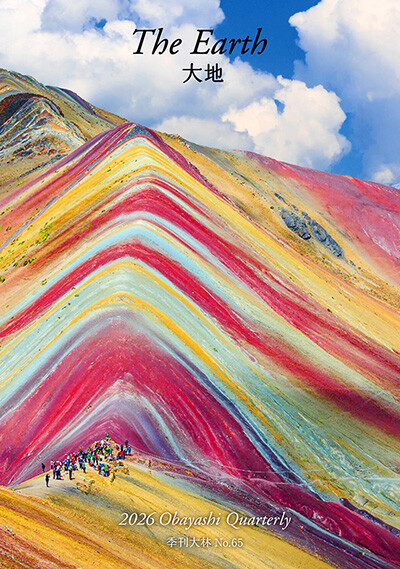
No.65 "Earth"
The earth nurtures life and sustains the rich natural environments that surround us. We live each day benefiting from its blessings. How did the earth come into being? And is there land on planets beyond Earth?
This issue explores the diverse and colorful landscapes found around the world and the ways in which they are intertwined with people’s lives. We also trace the geological processes that have shaped these distinctive landscapes. In the Obayashi Project, we took on the ambitious challenge of conceptualizing the creation of habitable terrain and the development of an environment capable of sustaining life inside a Martian crater.
We reflect on the richness and significance of the natural world nurtured by the earth and turn our thoughts to the future of our planet’s environment.
(Published in 2026)
-
The Colors and Expressions of the Earth
- View Detail
-
Earth's Soil and Planetary Soil
FUJII Kazumichi
(Unit Leader, Soil Homeostasis Research Unit, Fukushima Institute for Research, Education and Innovation) - View Detail
-
Who Owns Land in Space?: Rethinking the Ethics of Terraforming
MOTOMURA Yukiko
(Special Visiting Professor, Faculty of Life and Medical Sciences, Doshisha University; Guest Editor, The Mainichi Newspapers Co., Ltd.) - View Detail
-
Terraforming: Ecosynthesis and Ecological Restoration on Mars
Christopher P. McKay
(Planetary Scientist; Senior Scientist, NASA Ames Research Center) - View Detail
-
OBAYASHI PROJECT
Creating Habitable Terrain on Mars: Crater Paraterraforming
Concept: Obayashi Project Team
- View Detail
-
Dreams of the Red Earth: Five Hundred Years of Martian Settlement
TAKEUCHI Kaoru
(Science Writer; Professor, Faculty of Social Informatics, ZEN University) - View Detail
-
The "Earthen Houses" of Iceland
FUJIMORI Terunobu
(Architectural historian and architect; Director, Tokyo Metropolitan Edo-Tokyo Museum; and Emeritus Professor, University of Tokyo) - View Detail
-
The Earth's Memory: Landscapes Shaped by Nature and Human Life
- View Detail