

Creating Habitable Terrain on Mars: Crater Paraterraforming
Concept: Obayashi Project Team
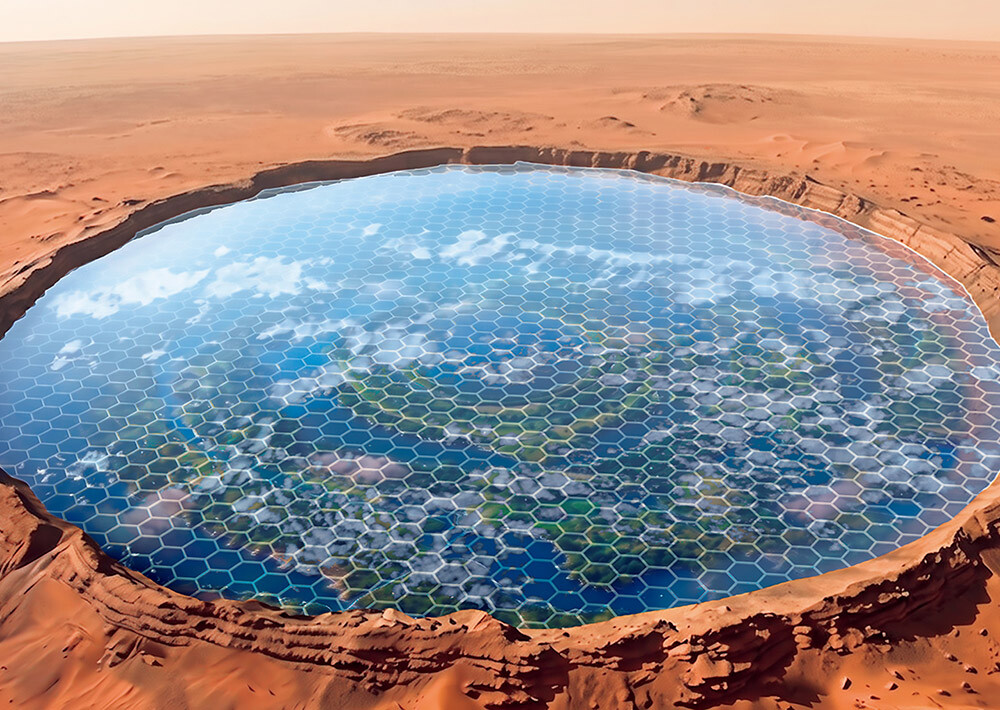
4. Creating a Self-Sustaining Natural Cycle
Remediation of Perchlorate-Containing Soil
Martian regolith contains high concentrations of perchlorates, substances harmful to living organisms. If ingested by humans, they can adversely affect thyroid function and other physiological systems. In California, for example, drinking water standards impose a stringent regulatory limit of no more than 6 ppb. Perchlorates are also found on Earth in arid regions of the United States and in Chile's Atacama Desert, and are used in various industrial applications, where they have become a source of soil and groundwater contamination around factory sites.
Several conditions must be satisfied before soil remediation can begin: the canopy must already be in place so that temperatures have risen to levels suitable for microbial growth, the impermeable layer on the crater floor must be completed, a stable supply of electrical energy must be available, and systems for supplying water containing little to no perchlorate must be established. Once these requirements are met, full-scale remediation operations commence.
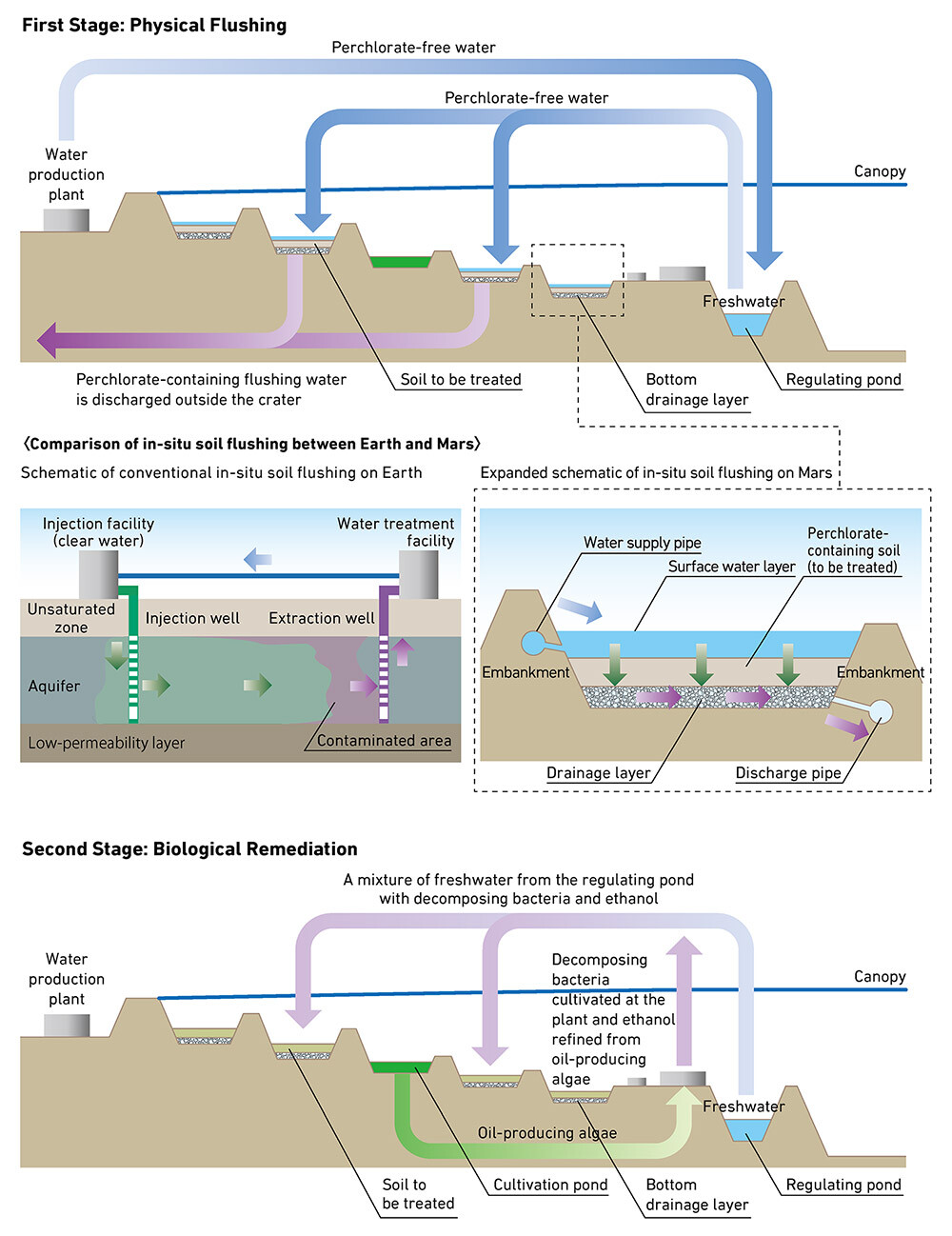
To address these challenges, the project team devised a two-stage remediation process based on soil treatment technologies that Obayashi has developed and refined on Earth. The first stage involves physical remediation. Being that perchlorates readily dissolve in water, regolith is placed into the water basins after cyanobacteria cultivation has been completed, and freshwater is passed downward through the soil and collected below, thereby washing out the contaminants. This approach applies the principles of in-situ soil flushing (*13) for contaminated soil in a vertical configuration.
The second stage is biological remediation, or bioremediation. Once in-situ soil flushing has reduced perchlorate concentrations to lower levels, anaerobic microorganisms (decomposing bacteria) capable of decomposing perchlorates are introduced into the soil. Bioethanol produced from oil-generating algae cultivated in advance in a portion of the water basins is used as a nutrient source for the microorganisms. These oil-producing algae are cultured separately from the cyanobacteria and refined into ethanol at an algal cultivation plant. The microorganisms then break down the perchlorates into harmless chloride and water. The chlorine is subsequently combined with sodium, which is abundant on Mars, and recovered as sodium chloride to form part of the "seawater" composition in the central regulating pond. Such soil remediation technologies are already in practical use today, supporting the feasibility of paraterraforming.
*13 A remediation method that controls the flow of water through soil using injection and extraction wells to treat contaminated soil in situ.
[Remediation Process]
Creating Weather
What kind of weather would emerge beneath the canopy? The project team conducted climate simulations to examine temperature, wind, clouds, and precipitation within the canopy.
Starting with temperature, because Mars lies roughly 1.5 times farther from the Sun than Earth, the amount of solar energy reaching the planet is only about 0.43 times that received by Earth—roughly 590 W/m2. After passing through the canopy, only around 20 % of that energy ultimately reaches the ground surface.
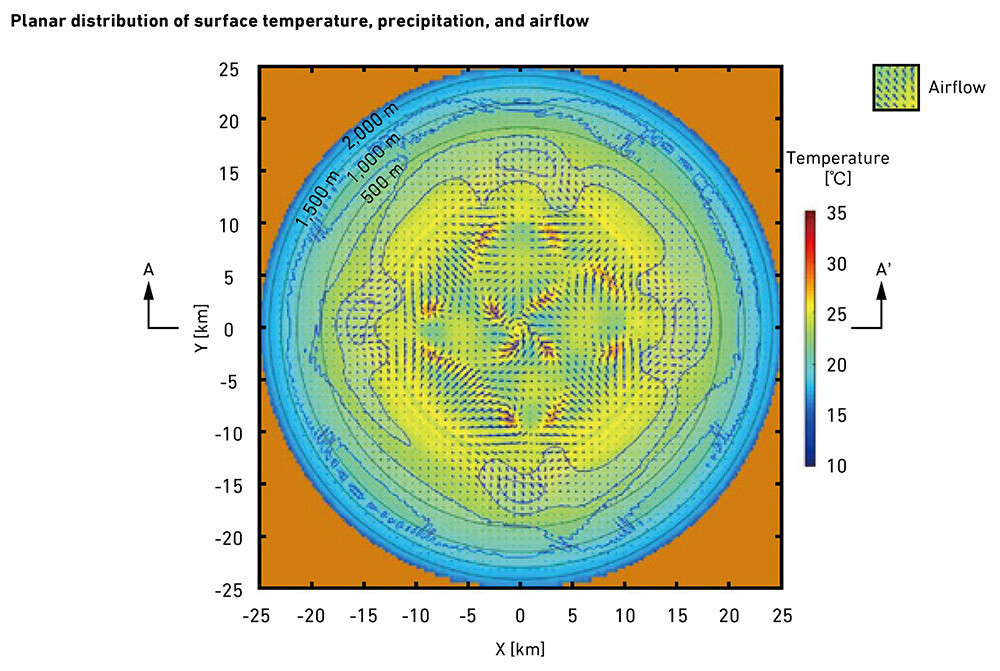
Even so, the interior environment would remain within a range of roughly 10-30 ℃, including seasonal variations. This is because the canopy's water layer possesses a large thermal capacity, while its thermal insulation and thermal-radiation shielding layers function as a "blanket" that prevents internal heat from escaping into the outside environment. The simulations reproduced a diurnal cycle similar to that of Earth, with temperatures rising during the day and falling at night. At approximately 25 °, the axial tilt of Mars is close to that of Earth, giving rise to seasonal changes over the course of the year. A Martian year corresponds to roughly two Earth years (687 Earth days), with long summers and long winters arriving gradually.
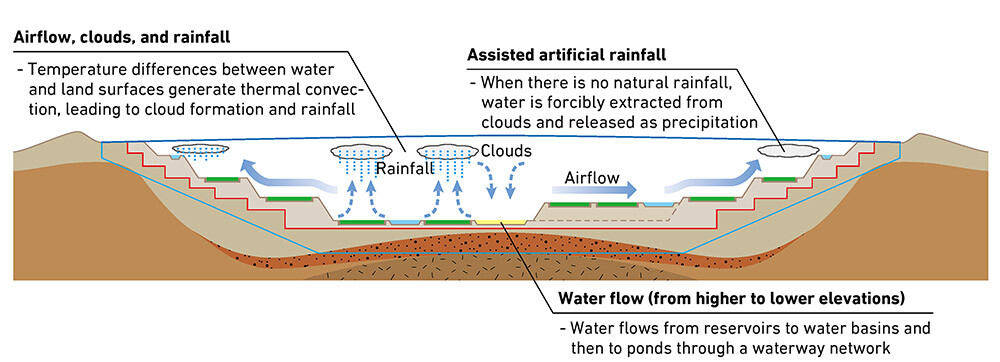
Wind also blows within the canopy. Temperature differences between bodies of water and land surfaces generate air currents, producing steady, gentle winds of around 1 m/s throughout the enclosed environment. This is sufficient to carry plant pollen. In addition, because of the Coriolis force (*14) generated by the planet's rotation, air currents flowing from the center of the crater toward the perimeter in the northern hemisphere exhibit a gentle clockwise rotation when viewed from above, while currents flowing from the perimeter toward the center rotate counterclockwise.
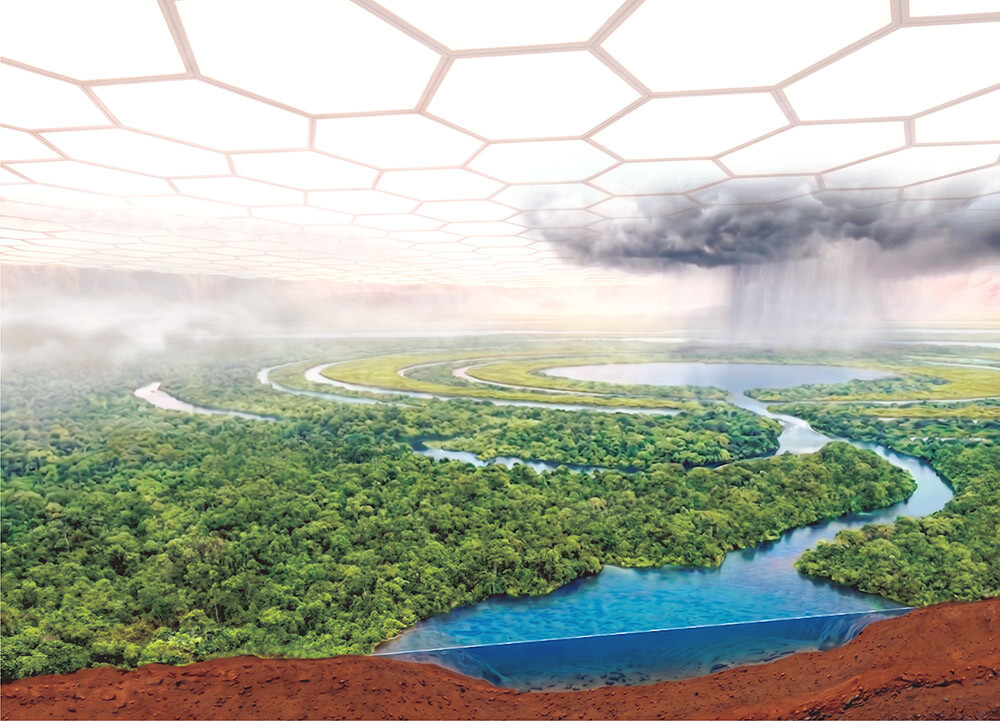
Clouds also form. In areas where updrafts occur, air rises along with the airflow, cools, and condenses to form water droplets (cloud droplets), which cluster together to create clouds. Precipitation also occurs, and dew forms on the ground surface. There is, however, one important difference from Earth. Within the canopy, substantial rainfall is less likely to occur.
*14 A pseudo-force that acts on a moving object relative to a rotating body
[Three-Dimensional Weather Simulation Inside the Crater]
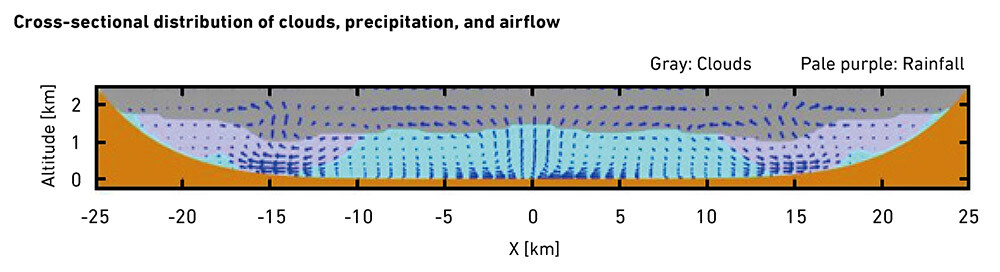
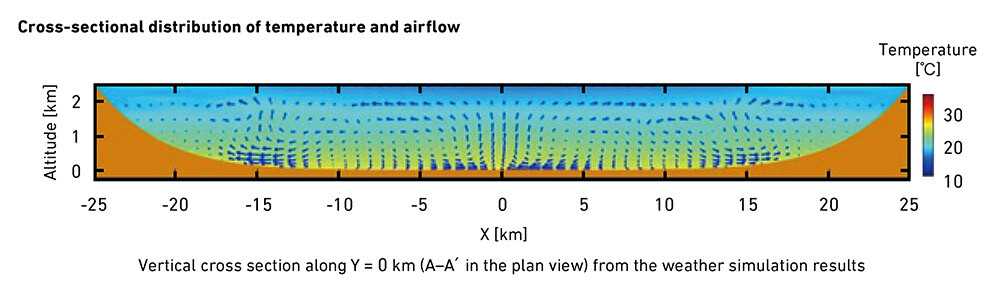
There are two reasons for this. The first is that Martian gravity is only about one-third that of Earth. On Earth, when air rises by 1 km, adiabatic expansion lowers its temperature by roughly 10 ℃. On Mars, by contrast, the weaker gravity limits this temperature decrease to only around 3.5 ℃. As a result, water vapor condenses less readily as the air rises, making it more difficult for sufficient quantities of cloud droplets to develop into raindrops. The second reason is that the height to which air can rise is constrained by the height of the canopy itself. If moist air is able to ascend sufficiently high, temperatures continue to decrease with altitude, making cloud and rain formation more likely. Within the canopy, however, this process is limited. There is insufficient vertical space for tall clouds like the towering cumulonimbus clouds seen on Earth to develop. Consequently, only small amounts of condensed water droplets form from clouds, and condensation from the canopy itself becomes the primary source of water. For this reason, artificial systems will also assist in maintaining the internal water cycle. One approach would be to use forced dehumidification systems to mechanically condense and recover moisture (water vapor), which tends to accumulate near the canopy because it is lighter than carbon dioxide, oxygen, and nitrogen molecules. The recovered water would then be supplied to soils and water basins through a network of waterways. Preliminary estimates indicate that the energy required for dehumidification reaches several tens of gigawatts. On Earth, the water cycle occurs naturally through atmospheric processes; on Mars, however, without some form of intervention, maintaining such a cycle would require enormous infrastructure and energy inputs. Carbon dioxide required for sustaining photosynthesis is also utilized in an artificial precipitation process. When fine particulate dry ice produced from carbon dioxide in the Martian atmosphere is dispersed within the canopy, the surrounding moist air is locally cooled, and the dry ice particles function as ice nuclei that promote the growth of raindrops. Furthermore, as the photosynthetic activity of fungi and plants intensifies, spores, pollen, and other biological particles released by these organisms become suspended within the atmosphere and act as additional ice nuclei inside cooled clouds. This creates a circulation in which artificial precipitation and a biological precipitation cycle are coupled, enabling precipitation that closely resembles natural rainfall. The quantity and timing of dry ice deployment are precisely controlled through robotic and AI technologies based on numerical climate models. As ecosystem functions mature, temperature and humidity within the enclosed environment are maintained within ranges suitable for biological growth.
Such precipitation management systems may significantly reduce the energy demand associated with mechanical condensation and recovery by forced dehumidification systems, as well as the artificial water circulation maintained through the waterway network.
As described above, it is possible to reproduce the four essential elements of weather—temperature, wind, clouds, and precipitation—on Mars through paraterraforming.
[Airflow and Water Flow Inside the Canopy]
Material Cycles and Energy
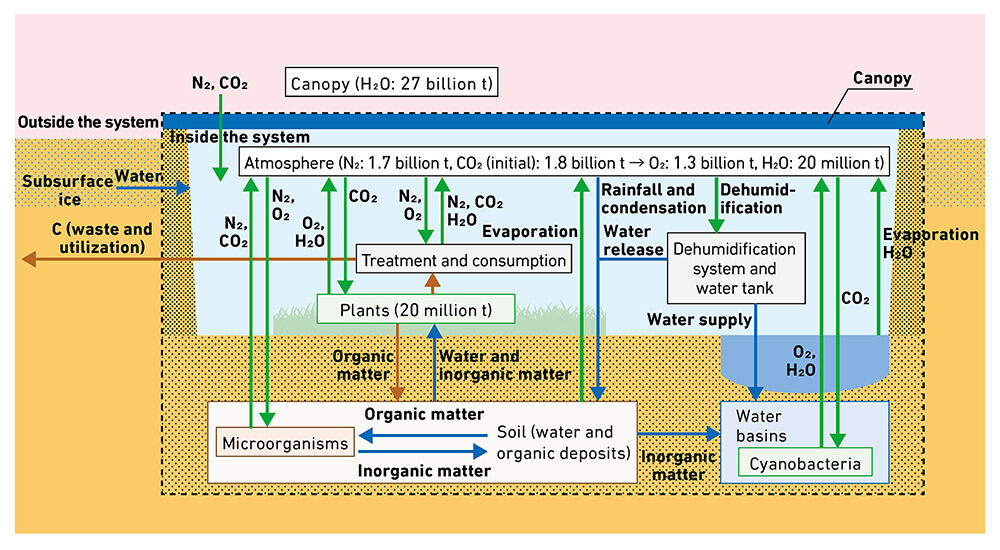
It has been confirmed through calculations that all materials required for paraterraforming can be procured locally on Mars. The largest requirement is the water for the canopy's water layer, at approximately 27 billion t. If subsurface ice is assumed to be recoverable from soil at a depth of around 3 m with a water content of 30 %, this amount could be supplied by excavating an area of roughly 170 km square.
While the nitrogen required for the atmosphere is approximately 1.7 billion t, more than 400 times that amount exists in the Martian atmosphere. This is sufficient for deploying paraterraforming across multiple craters. Accounting for 95 % of the Martian atmosphere, carbon dioxide is abundantly available. Approximately 1.3 billion t of oxygen are produced through photosynthesis. Essential plant nutrients such as phosphorus and potassium are also present in Martian soil at higher concentrations than on Earth.
However, in order to sustain an ecosystem within a closed environment, artificial control systems are indispensable in addition to natural material cycles. Of particular importance are the previously mentioned humidity control system and carbon recovery system.
In the initial stage, when there are few animals, carbon will tend to accumulate in plants. For this reason, mechanisms would be required to remove excess carbon, for example, by converting it into inorganic forms through processes such as carbonizing dead plant material and releasing it externally. The energy required to operate these systems is enormous. According to the estimates, artificial lighting alone for plant cultivation is estimated to require roughly 200 gigawatts.
The project team identifies nuclear fusion power as the most promising option. Using deuterium contained in Martian water as fuel, 1 g of deuterium can generate energy equivalent to 8 t of oil. If deuterium obtained as a byproduct during water recovery is stored, it is calculated that sufficient fuel could be secured for more than 10,000 years even with a constant power consumption of 200 gigawatts. Nuclear fusion is currently targeted for practical application on Earth around 2050, and is therefore well within the paraterraforming timeline.
As supplementary power sources, a range of systems are also assumed: space-based solar power satellites placed in Martian geostationary orbit transmitting energy via lasers and mirror satellites that reflect sunlight directly into the canopy. Since dust accumulation on the outer surface of the canopy reduces both power generation and light transmittance, countermeasures against Martian dust storms are essential. After each storm, autonomous drones would be deployed to remove dust from the canopy surface, maintaining the light environment.
Materials and equipment that cannot be produced on Mars are transported from Earth via a "space elevator."
When considering the transportation of necessary materials from Earth to Mars, logistics cost remains a persistent challenge. Fortunately, the greatest advantage of Mars is that almost all required materials can be obtained locally. Beyond forming an atmosphere using nitrogen and carbon dioxide, the planet's surface materials can be processed into construction materials, and elements contained in these materials can be used to produce fluoropolymers and plastics. Construction materials can also be produced through sintering, while iron and aluminum can be extracted through refining and processed into metal products.
Over the long timescale of paraterraforming, these processes are expected to be carried out autonomously by on-site manufacturing robots utilizing AI and physical AI systems. The microorganisms, plants, and animals that form the core of paraterraforming can also be propagated simply by transporting cells and digital DNA data, using water, carbon, nitrogen, and other local resources. The design philosophy of Martian paraterraforming is therefore fundamentally based on maximizing the use of local resources.
Even so, the minimal personnel and cargo that must be transported to Mars will be handled by the space elevator capable of dramatically reducing transportation costs. By installing infrastructure not only on Earth but also on Mars, both planets can benefit from reduced launch and return costs. Regular shuttle transport services would likely be operated.
[Material Cycles and Estimation of Required Resource Quantities]
- The first page
- Previous page
- page 1
- page 2
- page 3
- Current page: page 4
- page 5
- 4 / 5
- Next page
- The last page
The issue this article appears

No.65 "Earth"
The earth nurtures life and sustains the rich natural environments that surround us. We live each day benefiting from its blessings. How did the earth come into being? And is there land on planets beyond Earth?
This issue explores the diverse and colorful landscapes found around the world and the ways in which they are intertwined with people’s lives. We also trace the geological processes that have shaped these distinctive landscapes. In the Obayashi Project, we took on the ambitious challenge of conceptualizing the creation of habitable terrain and the development of an environment capable of sustaining life inside a Martian crater.
We reflect on the richness and significance of the natural world nurtured by the earth and turn our thoughts to the future of our planet’s environment.
(Published in 2026)
-
The Colors and Expressions of the Earth
- View Detail
-
Earth's Soil and Planetary Soil
FUJII Kazumichi
(Unit Leader, Soil Homeostasis Research Unit, Fukushima Institute for Research, Education and Innovation) - View Detail
-
Who Owns Land in Space?: Rethinking the Ethics of Terraforming
MOTOMURA Yukiko
(Special Visiting Professor, Faculty of Life and Medical Sciences, Doshisha University; Guest Editor, The Mainichi Newspapers Co., Ltd.) - View Detail
-
Terraforming: Ecosynthesis and Ecological Restoration on Mars
Christopher P. McKay
(Planetary Scientist; Senior Scientist, NASA Ames Research Center) - View Detail
-
OBAYASHI PROJECT
Creating Habitable Terrain on Mars: Crater Paraterraforming
Concept: Obayashi Project Team
- View Detail
-
Dreams of the Red Earth: Five Hundred Years of Martian Settlement
TAKEUCHI Kaoru
(Science Writer; Professor, Faculty of Social Informatics, ZEN University) - View Detail
-
The "Earthen Houses" of Iceland
FUJIMORI Terunobu
(Architectural historian and architect; Director, Tokyo Metropolitan Edo-Tokyo Museum; and Emeritus Professor, University of Tokyo) - View Detail
-
The Earth's Memory: Landscapes Shaped by Nature and Human Life
- View Detail