



FOCUS: Design Stories
Kubota Global Institute of Technology

A Development Hub Designed Like a Town to Spark Innovation
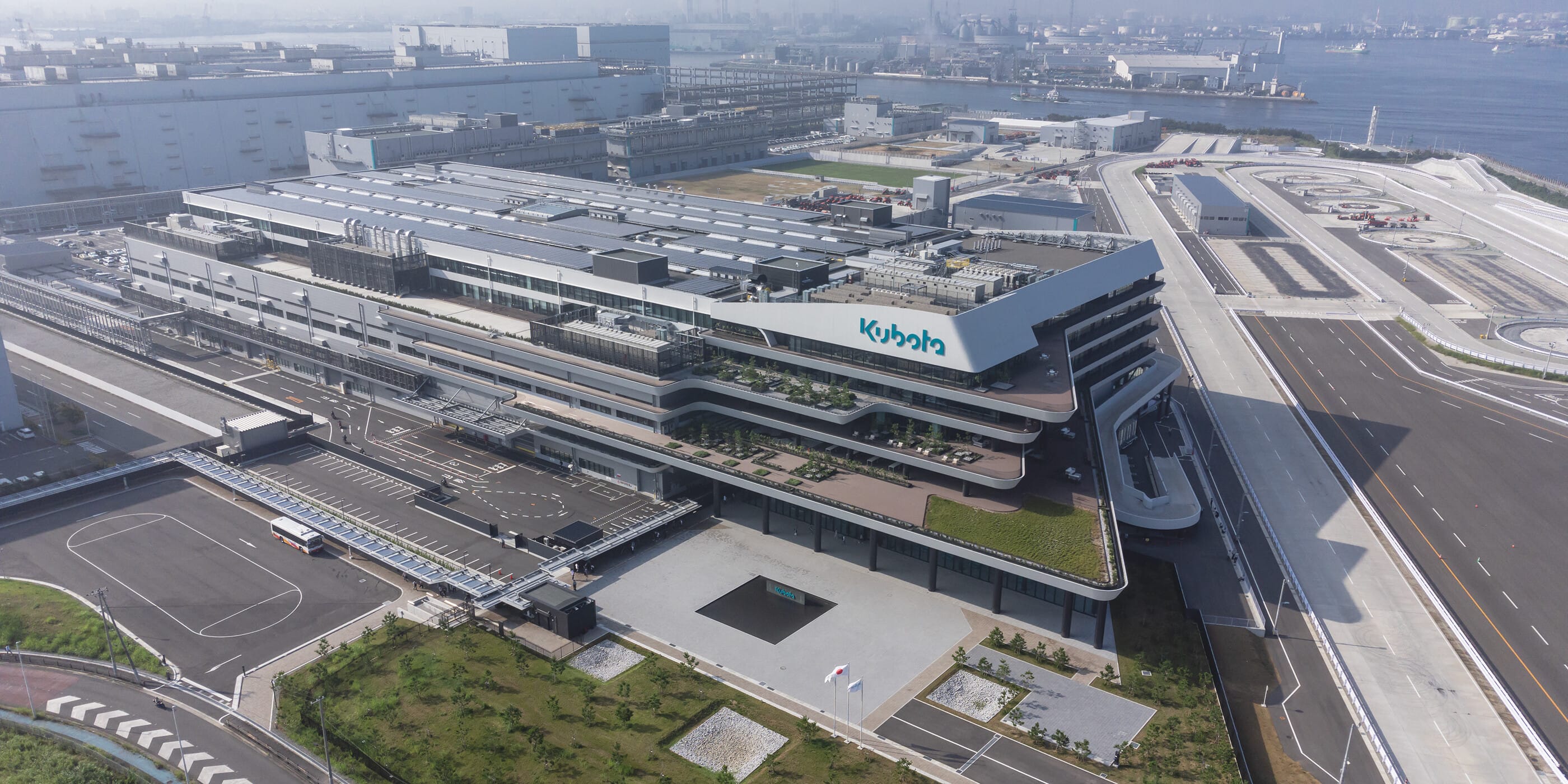
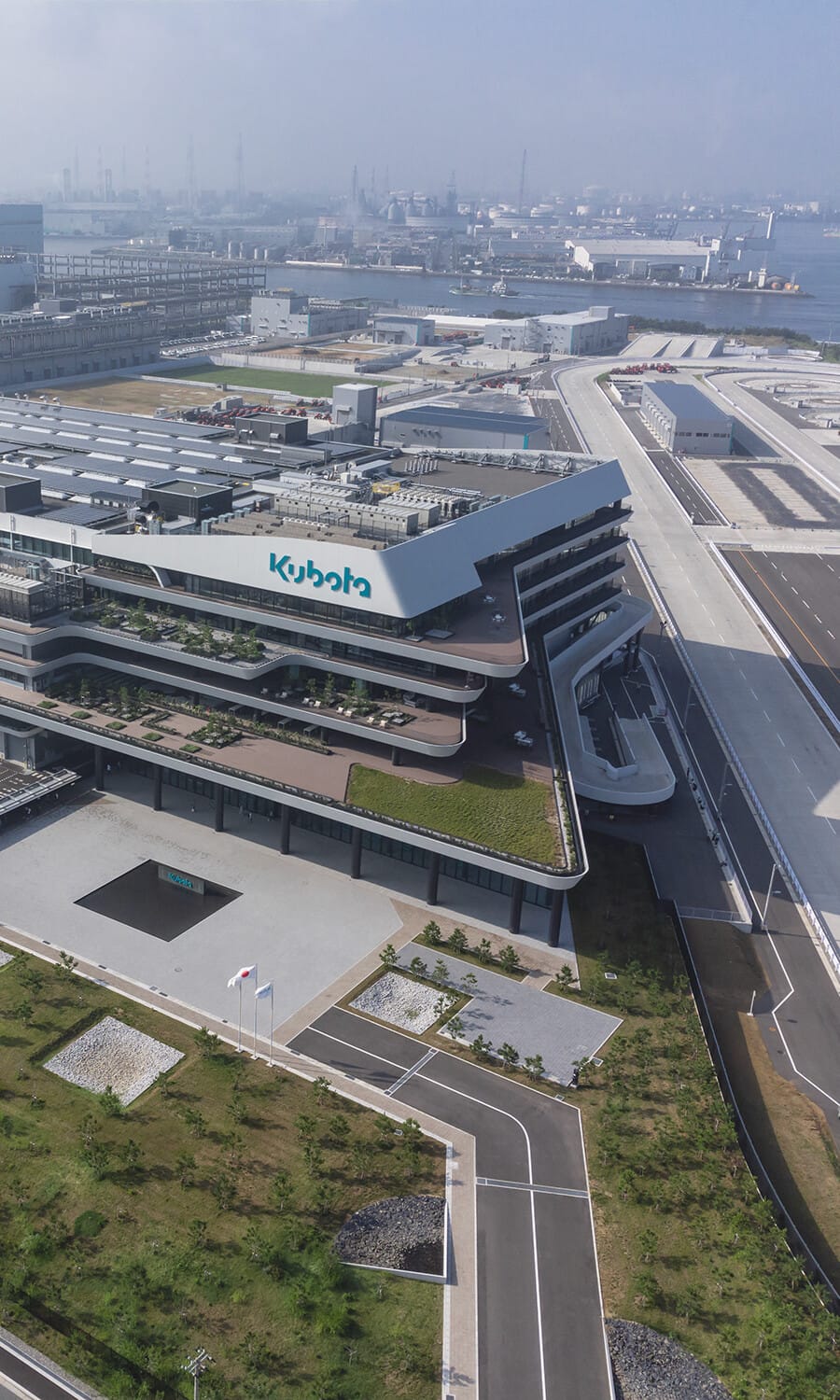
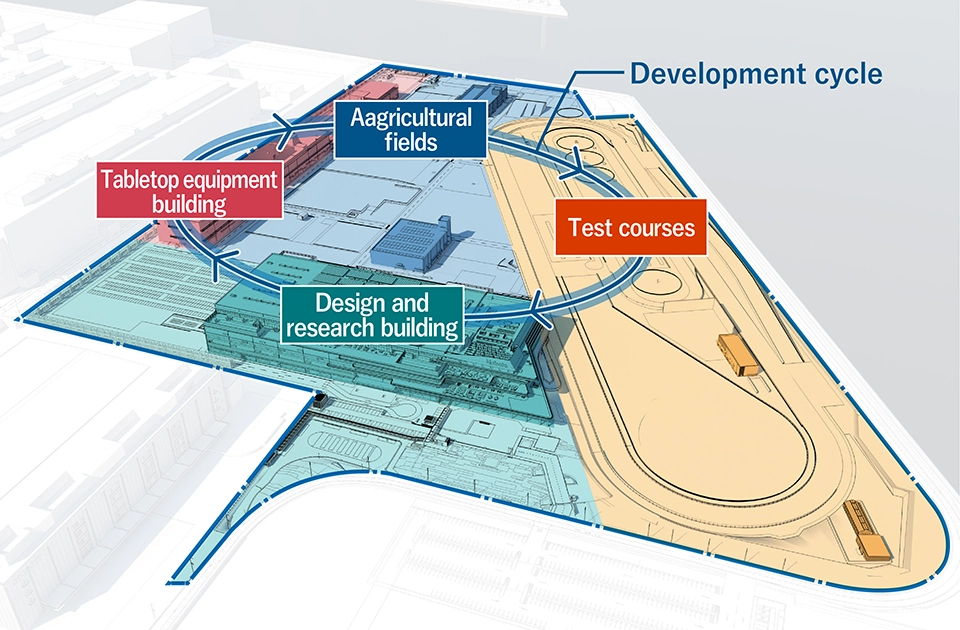
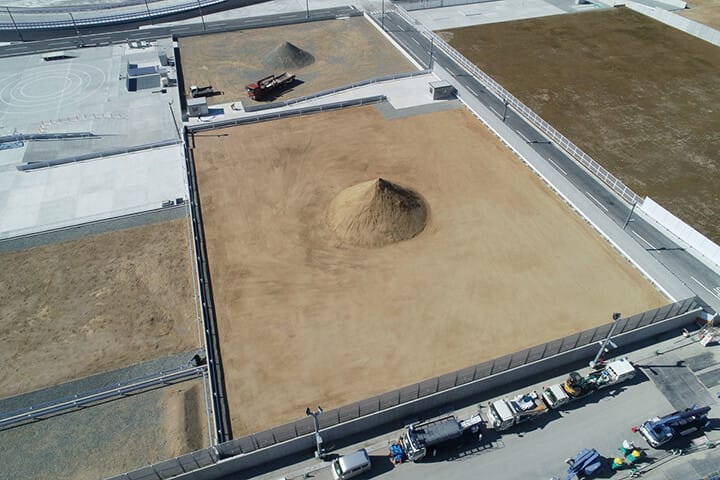
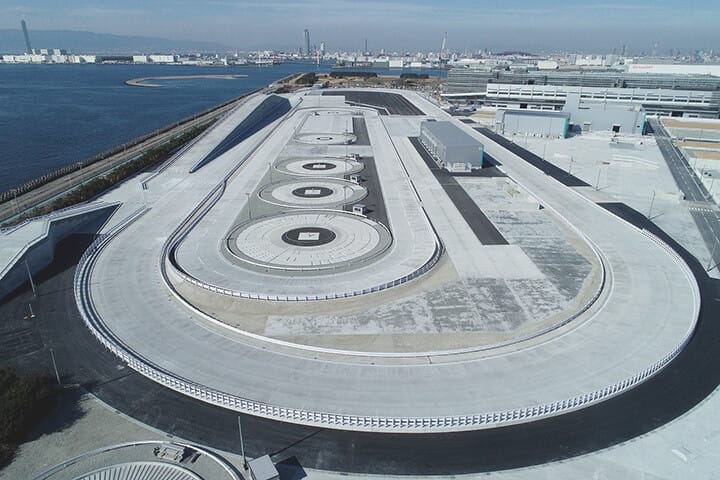
Kubota Global Institute of Technology (KGIT), completed in July 2022, is the research and development base of Kubota Corporation, a major agricultural machinery manufacturer also producing construction materials, steel pipes, and environmental equipment. KGIT was built on reclaimed land in the city of Sakai, Osaka, as a platform that enables unconstrained development activities, consolidating Kubota's research and development facilities that had been spread across the country, with many in the Kansai region. To streamline research and development, the vast site of approximately 346,000 m2 includes not only a design and research building but also test courses, agricultural fields, and testing equipment capable of 24-hour continuous automatic operation. Around 3,000 employees work on the premises.
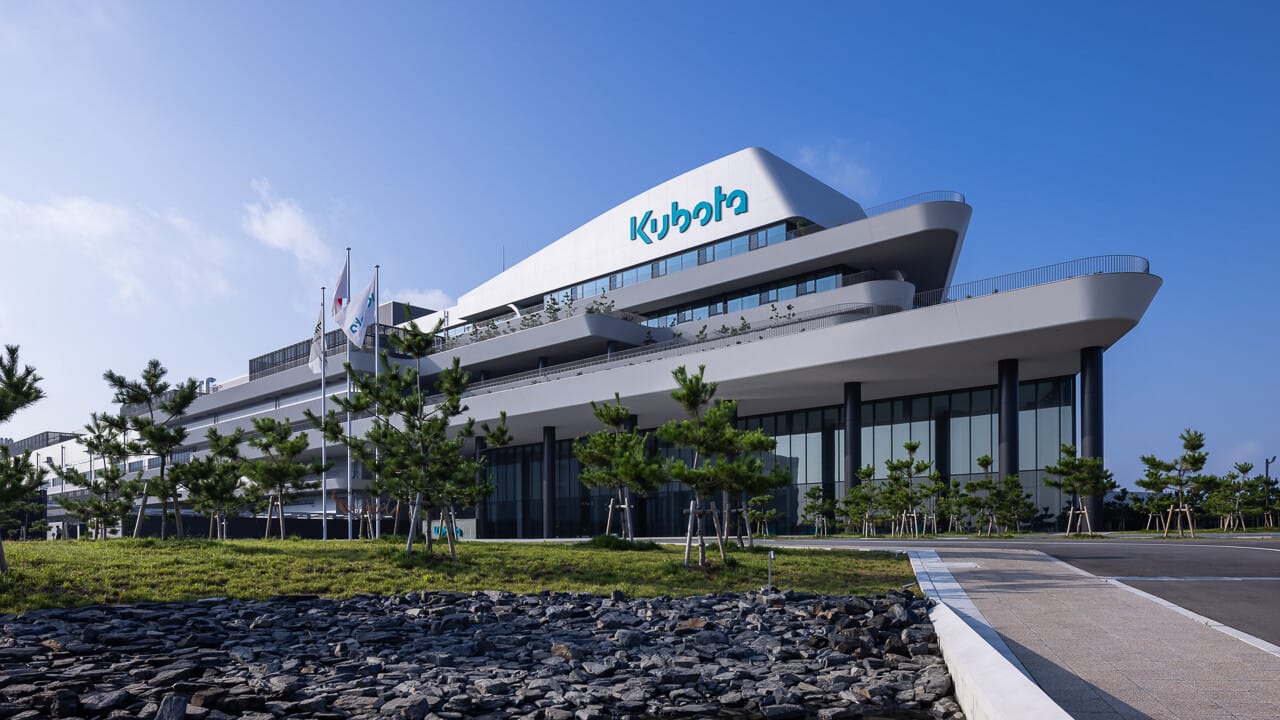
At the core of KGIT is the design and research building, created under the concept of "Cross innovation field—a place where innovation is generated at the intersection of all fields of expertise." The concept embodies the intent to foster the seeds of creation, as new possibilities are generated at the intersection between people, between knowledge and techniques, and between the internal and external spheres.
The design process for realizing the concept of KGIT is as follows.
- Consolidating Research Facilities Spread Out across Japan
- A Single-Floor Workplace that Fosters Spontaneous Communication
- The Central Atrium and Communication Staircase Linking Designers and Researchers
- Below the Design and Development Floor, where Silence is Required, Numerous Overhead Cranes Travel Freely
- Japan's Largest-Scale ZEB-Certified Building that Incorporated Various Technologies
- Rain Garden Serving to Purify and Regenerate Reclaimed Land
Consolidating Research Facilities Spread Out across Japan
Kubota's research facilities, which had been spread across the country, were brought together on this one vast site of approximately 346,000 m2. The consolidation removed previously existing limitations on development activities, including the number of development personnel that facilities can accommodate, long-distance travel between research facilities, and preparation time for durability tests. It has enabled development activities without previous constraints.
-
Agricultural fields -
Test courses -
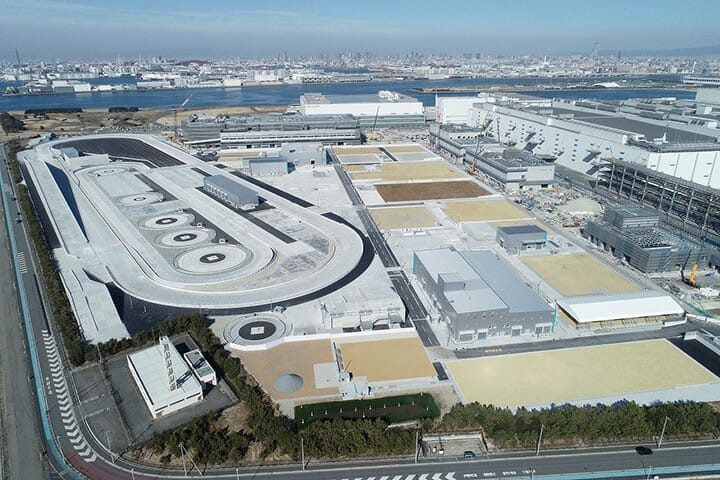
South-side view of entire site. Obayashi was responsible for the process from the land preparation through the construction of various facilities.
A Single-Floor Workplace that Fosters Spontaneous Communication
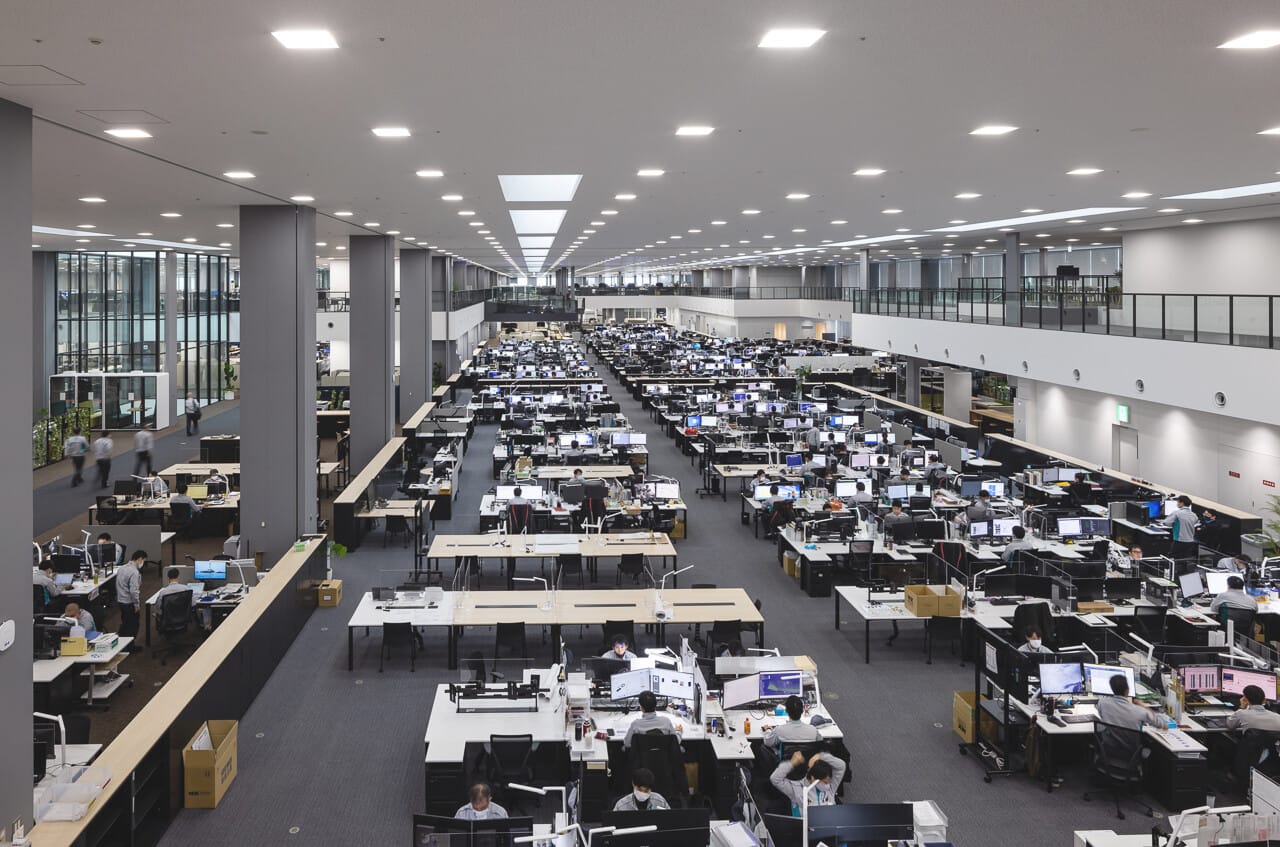
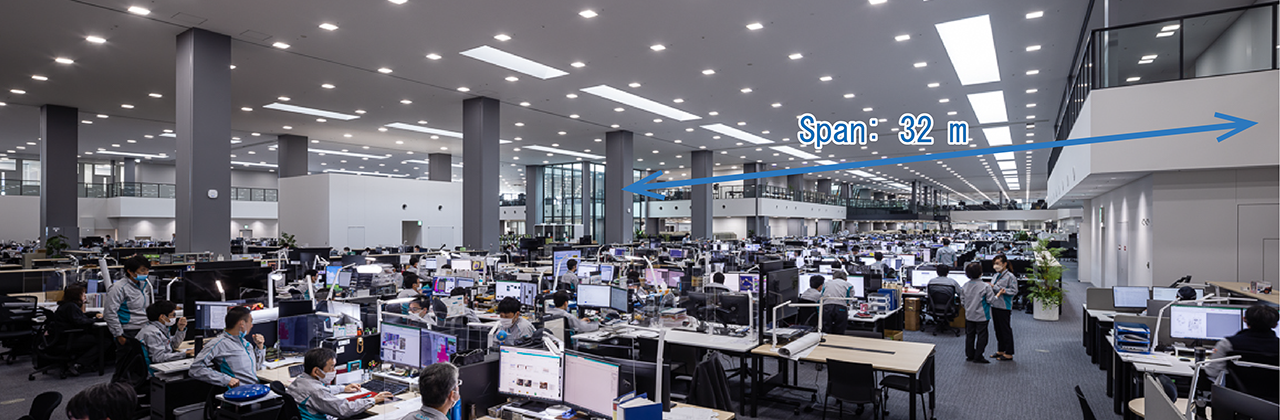
The workplace in the design and research building, which brings together diverse experts, was carefully designed to encourage the generation of novel innovations through synergy among divisions. In particular, the design and development floor, where 2,000 researchers gather to work, boasts a huge floor space of approximately 20,000 m2, which is 180 m long and 80 m wide, with a ceiling height of 7.5 m. Unlike multi-floor offices, the single-floor layout is conducive to fostering a sense of unity and spontaneous communication.
Likening the huge workplace to a town, the space was divided into division areas (blocks), aisles between the division areas (streets), and spaces for communication among the various researchers (parks and plazas). The division of space brought out the uniqueness of each division, while gathering them all on one floor created a diverse, high-density, and vibrant "town."
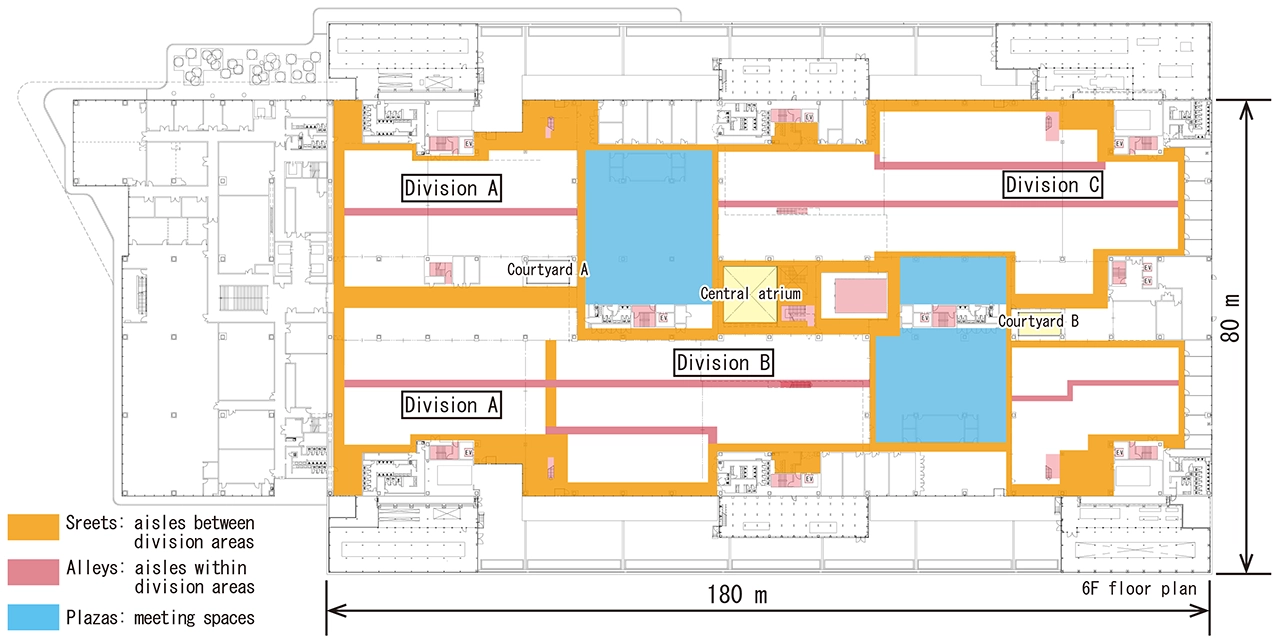
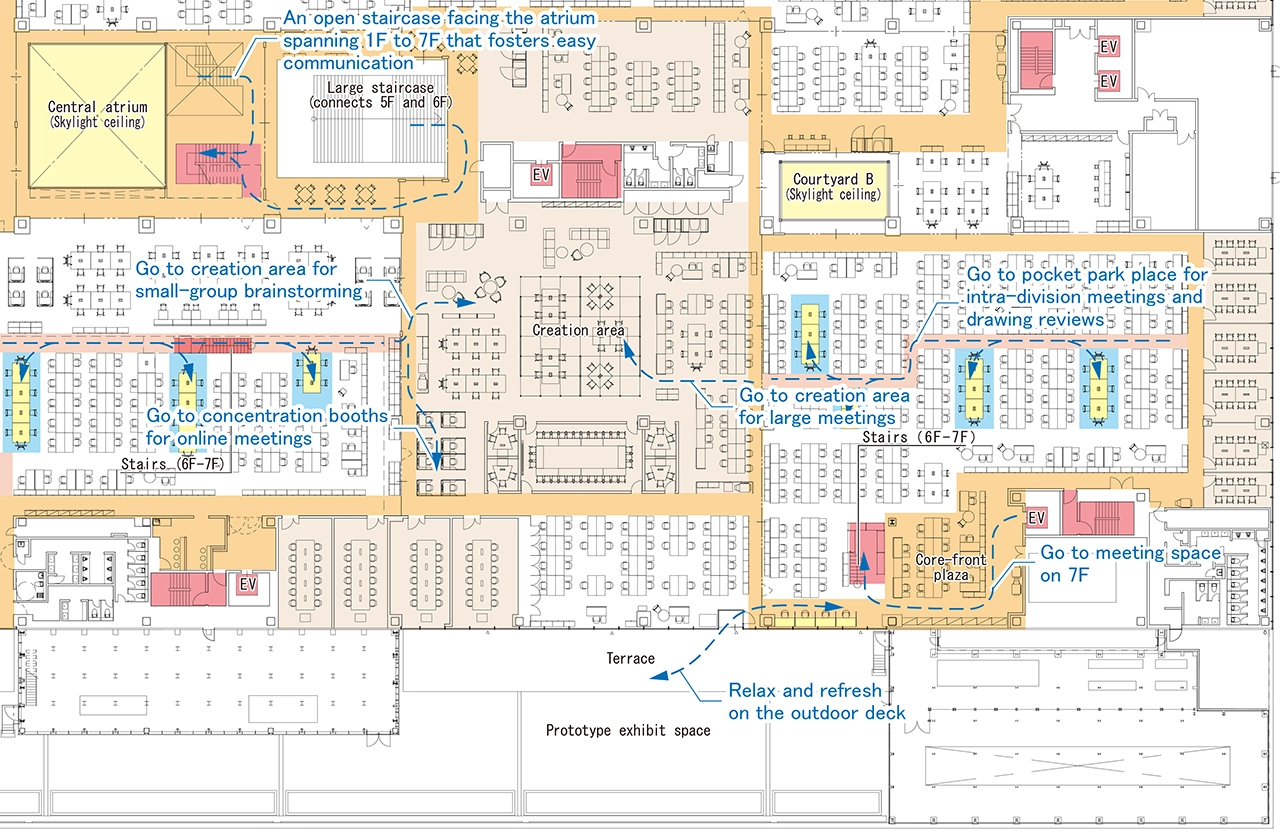
The workplace is dotted with communication spaces of all sizes, as well as stairs that connect the upper and lower floors and aisles. These features create a diverse office space. Bringing together numerous researchers and designers in one large space enhances the sense of unity and belonging, encouraging the generation of groundbreaking innovation of global scale.
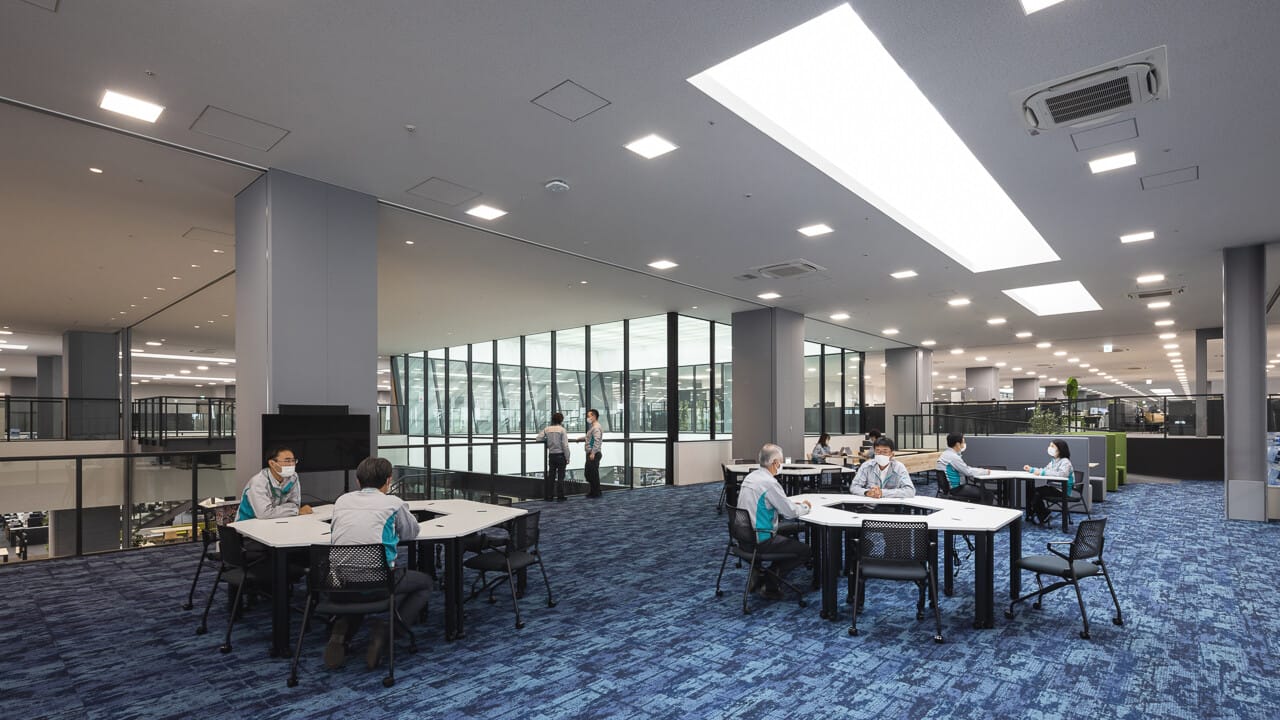
-
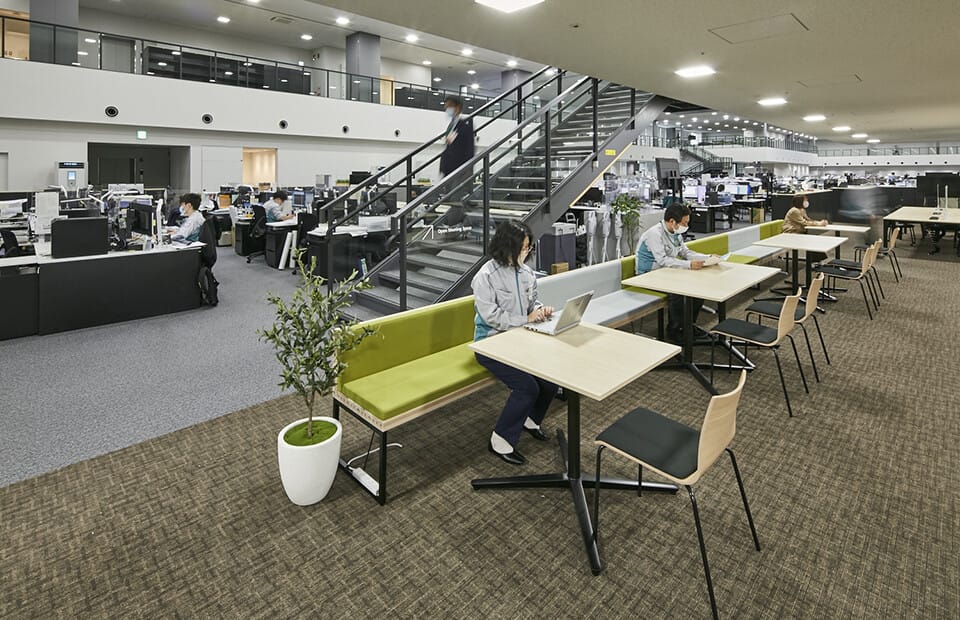
6F creation area -
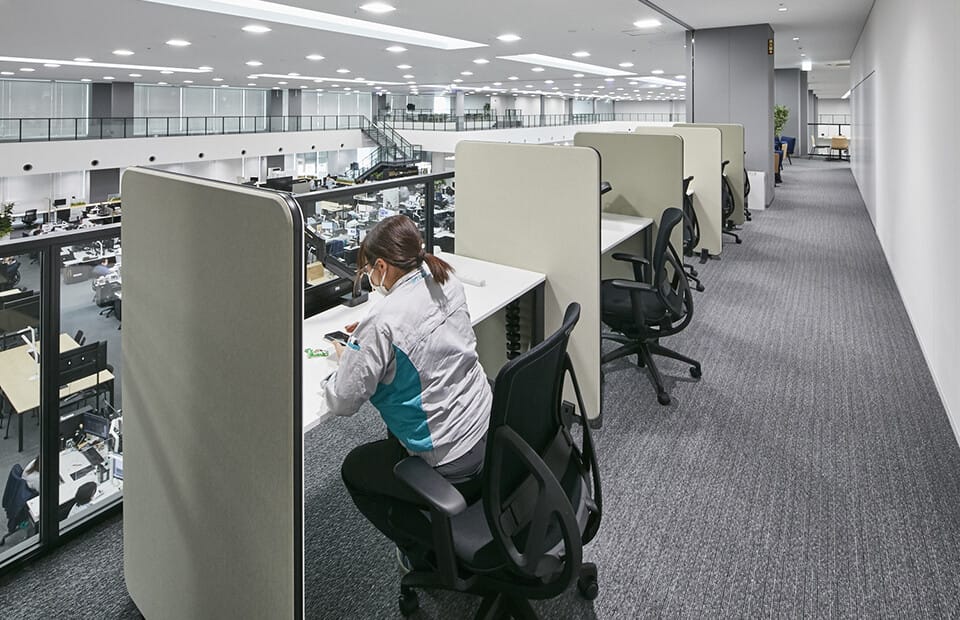
7F concentration area -
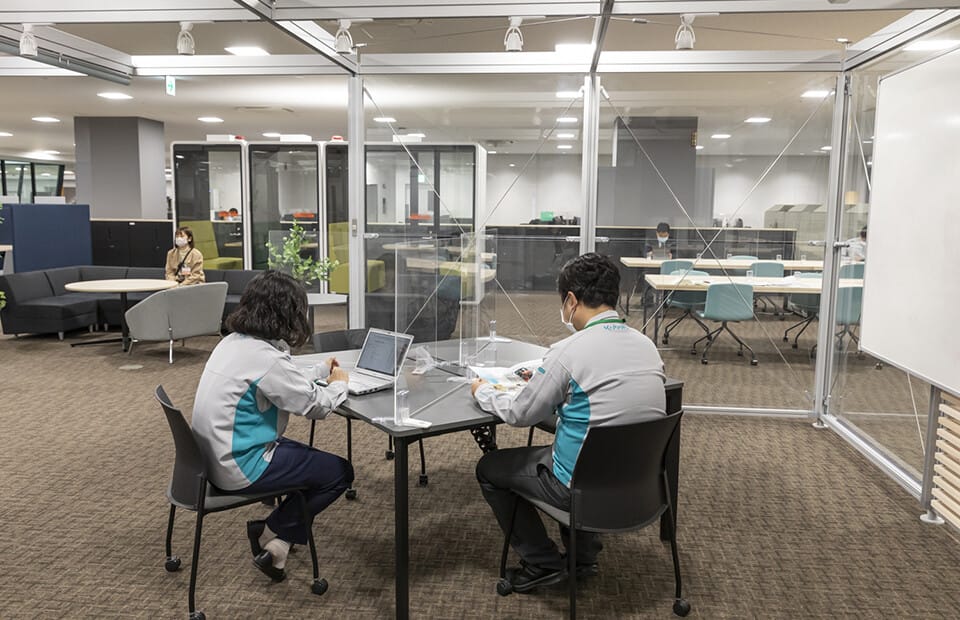
6F creation area -
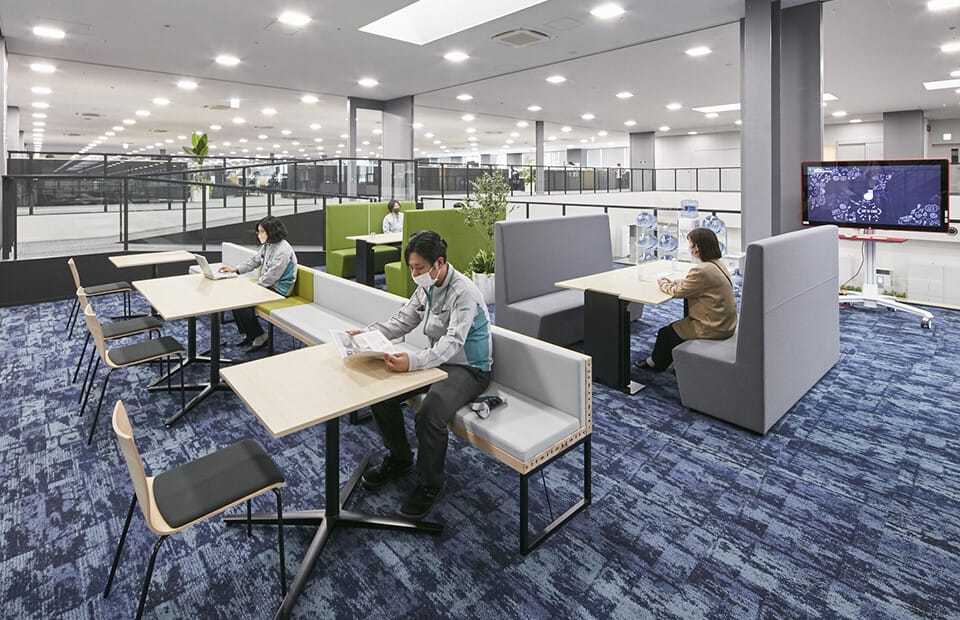
7F meeting lounge
The Central Atrium and Communication Staircase Linking Designers and Researchers
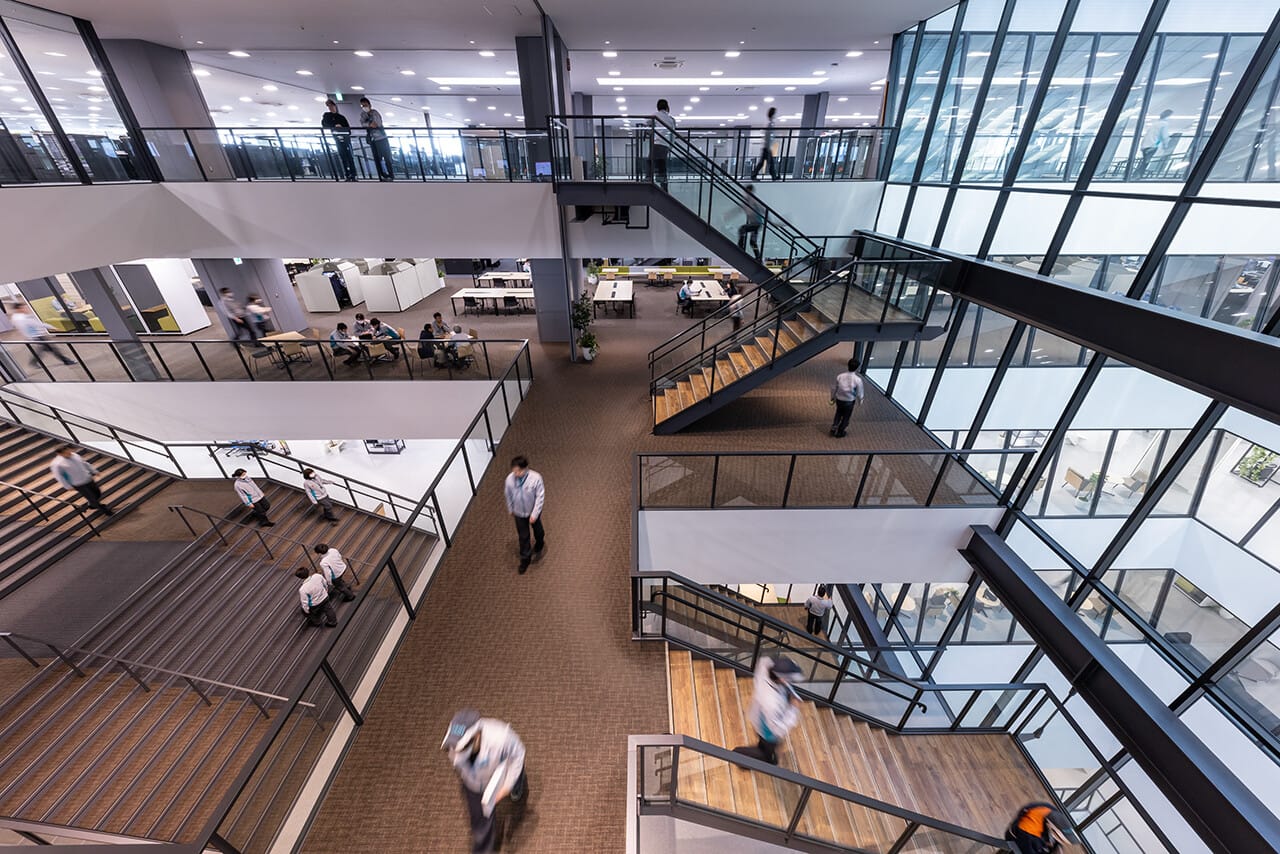
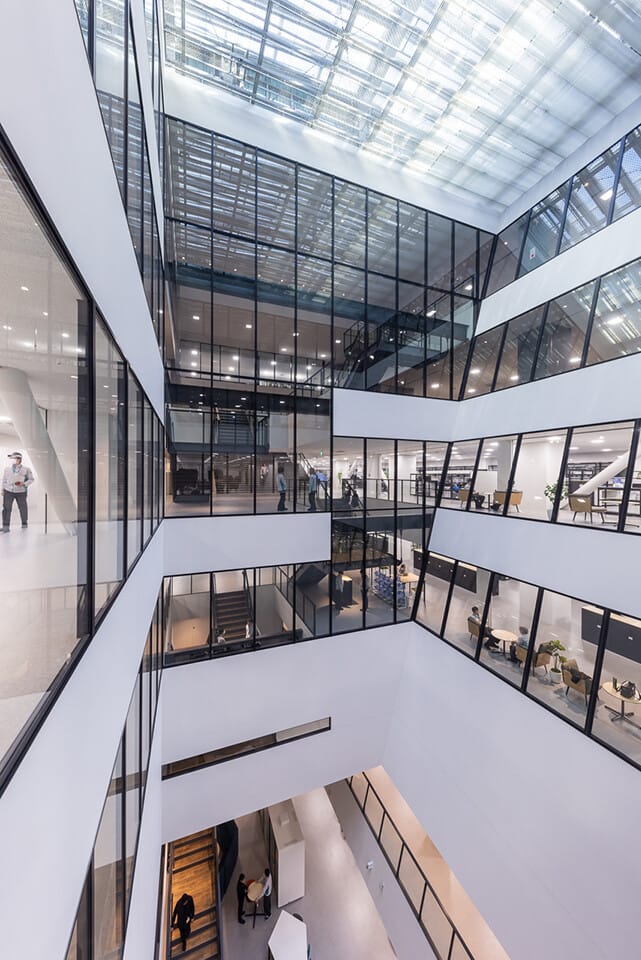
At the center of the design and research building is an atrium that lets in light all the way down to the first floor. The communication staircase is located not just for going to other floors, but also for encouraging communication among workers. Placed around the atrium and on the first floor are meeting spaces intended for gatherings of researchers that would lead to synergy generation.

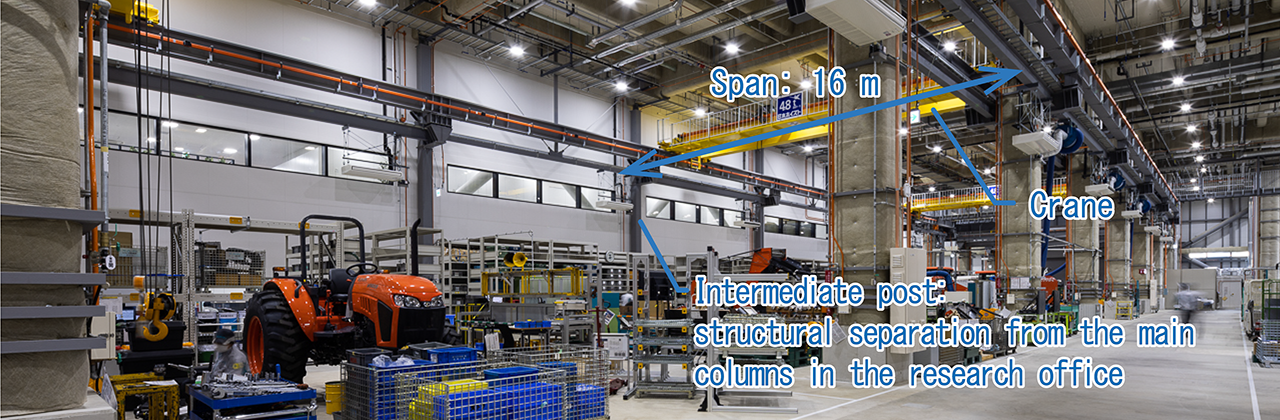
Below the Design and Development Floor, where Silence is Required, Numerous Overhead Cranes Travel Freely
The research area has a 16 m-by-10 m-span grid structure. In the huge space with a floor area of 112 m by 180 m, 113 overhead cranes travel freely. Right above the research space is the huge design and development floor designed to control vibration and noise. The building structure enables incorporation of contradictory elements of motion and stillness.
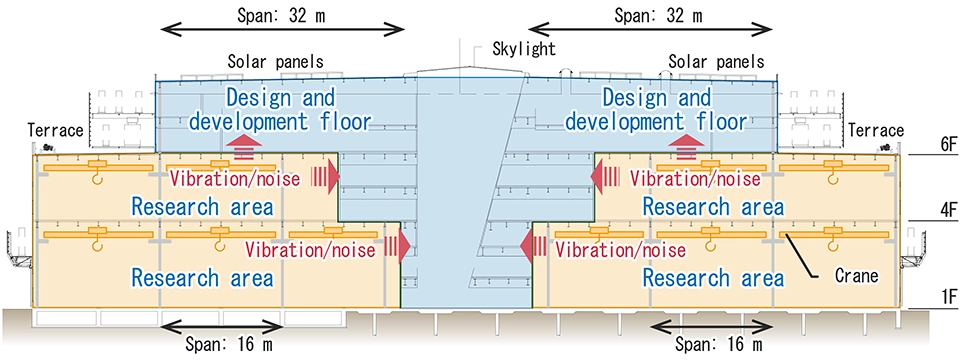
The design and development floor, where silence is a must, has a 20 cm-thick floor slab—thicker than standard—to prevent sound and vibrations from being transmitted to the space above. Because crane movements create large vibrations, thorough measures to control vibration and noise were taken, including fitting the cranes with rubber vibration isolators and urethane wheels. These measures helped the design and development floor acquire the highest performance rating in the Evaluation of Habitability to Building Vibration, a standard for building vibration and noise. They also resulted in a workplace environment where vibrations were unnoticeable.
Japan's Largest-Scale ZEB-Certified Building that Incorporated Various Technologies
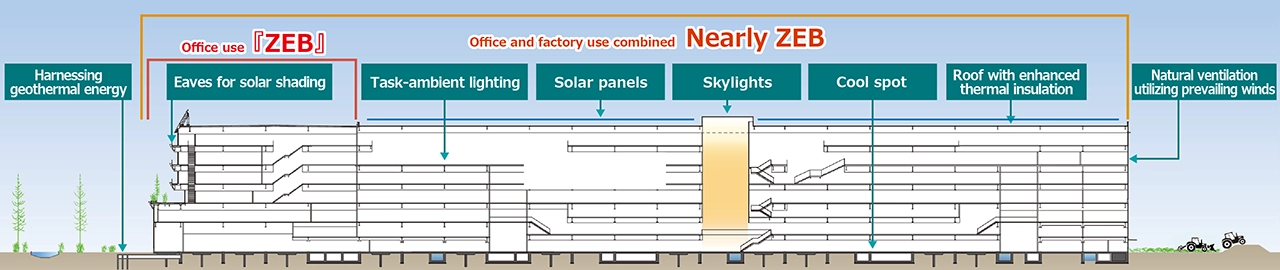
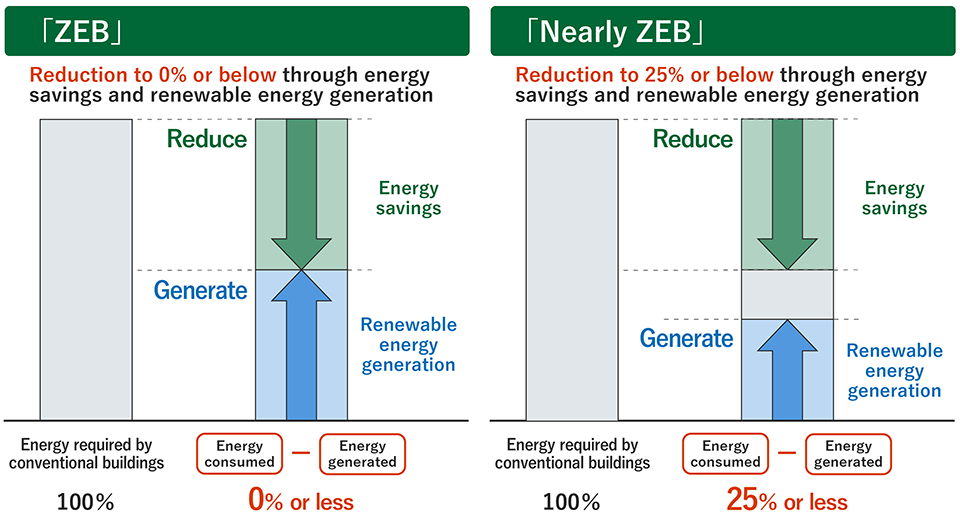
Various technologies to reduce energy use were incorporated in the design and research building. That helped the entire building, with a total floor space of 100,000 m2, reduce primary energy use by 75% to acquire Nearly ZEB (*1) certification. Furthermore, primary energy use of the building's office-use portion was reduced by 100% or more and acquired ZEB (*1) certification, making the structure the largest-scale building in the country to acquire ZEB certification.
-
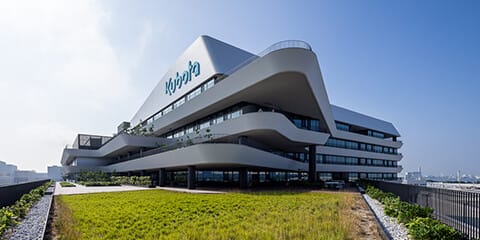
Terrace eaves for solar shading -
Harnessing natural energy with geothermal energy piles -
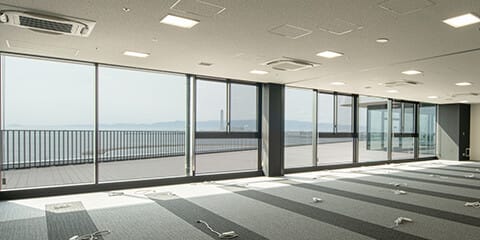
Natural ventilation utilizing prevailing winds (*2) -
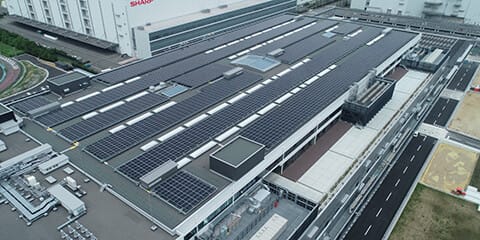
Solar panels also serving to block sunlight -

Task-ambient lighting for lighting each workspace separately contributes to energy savings -
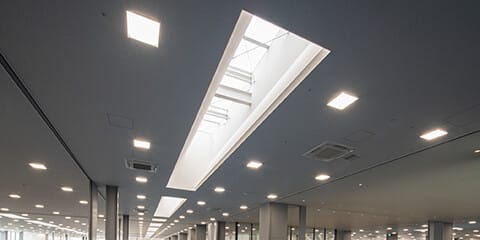
Ceiling skylights let in both natural light for lighting and outside air for cooling -
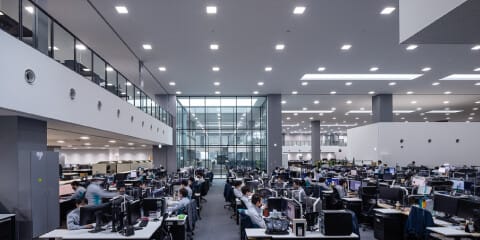
Air-wrap flow technology combining five air currents to increase air conditioning efficiency and comfort -
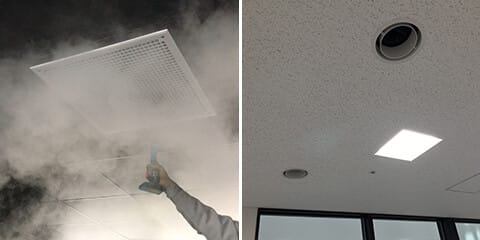
Moving flow (left), which helps biorhythm regulation, and cool spot (right) to cool the body after physical work
-
- *1 Net Zero Energy Buildings (ZEB) are buildings that achieve at least a 50% reduction in energy use from the baseline value through measures to save energy, as well as at least a 100% reduction through a combination of energy savings and renewable energy generation.
Nearly ZEB buildings are those that achieve at least a 50% reduction in energy use from the baseline value through measures to save energy, as well as at least a 75% reduction through a combination of energy savings and renewable energy generation. - *2 Winds that usually blow in a particular direction across a specific region during a particular season or time of year.
- *1 Net Zero Energy Buildings (ZEB) are buildings that achieve at least a 50% reduction in energy use from the baseline value through measures to save energy, as well as at least a 100% reduction through a combination of energy savings and renewable energy generation.
-
The mechanism of air-wrap flow
-
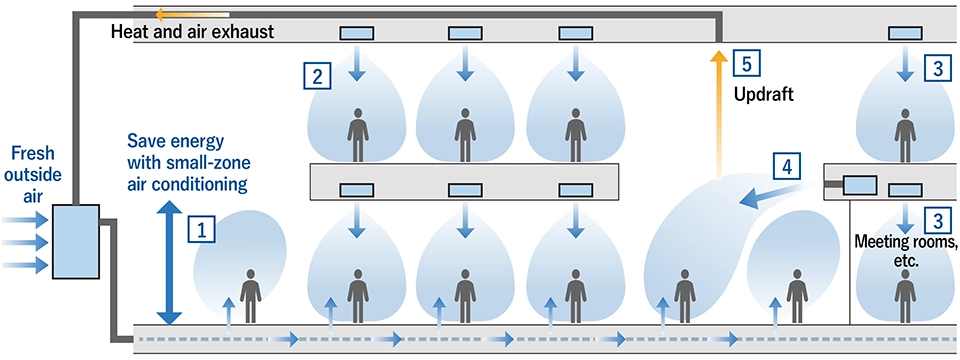
The air conditioning plan that combines five air currents to envelop workers in pleasant air. Of the five air currents, the personal floor vent serves to improve each worker's comfort despite being in a large space. -
1
Personal floor vent (fresh outside air) 2Ceiling cassette air conditioner with sensing capabilities 3Ceiling cassette air conditioner enabling temperature control by room 4Nozzle diffuser (air conditioning) 5Updraft that guides heat and air out
Rain Garden Serving to Purify and Regenerate Reclaimed Land
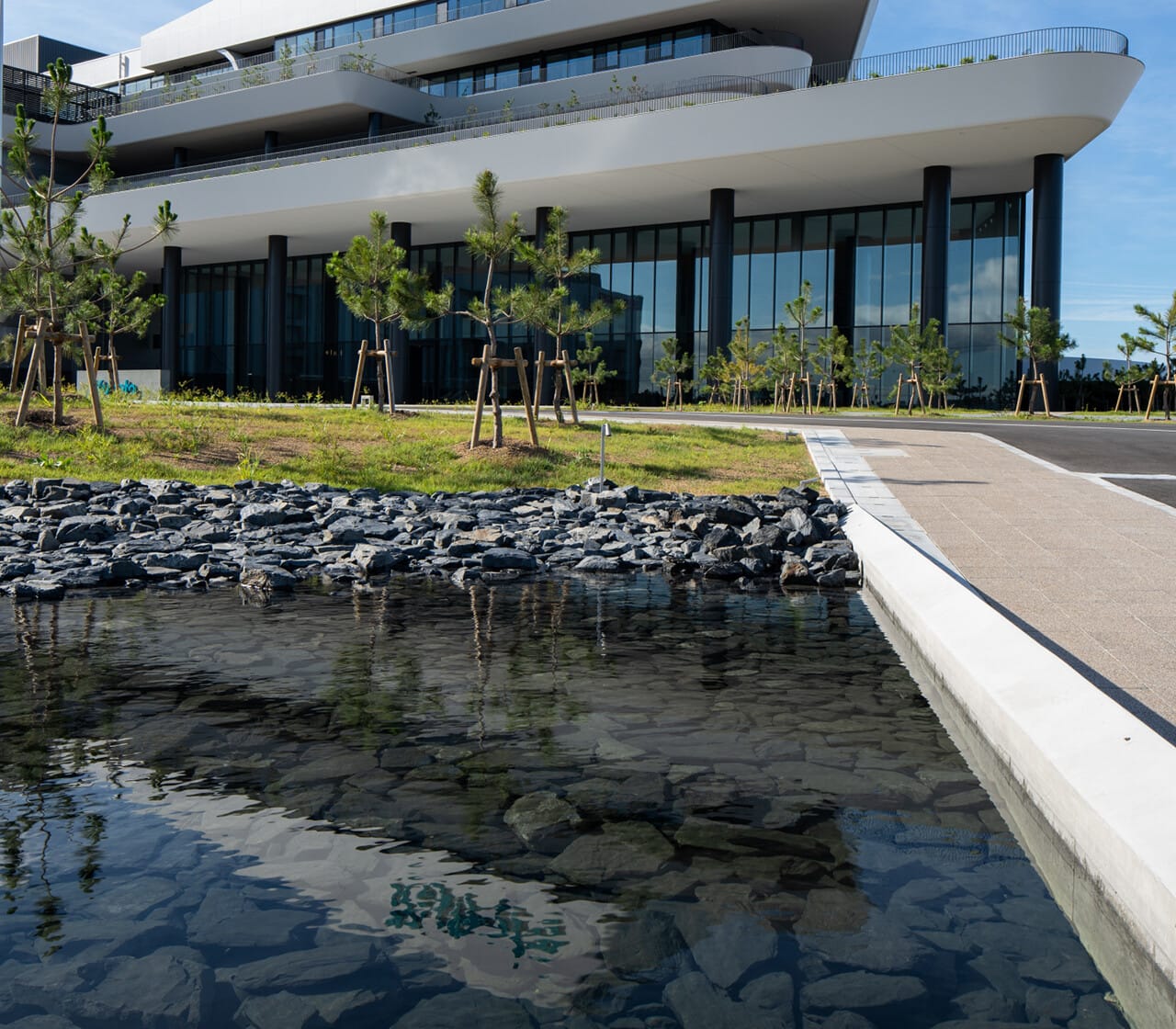
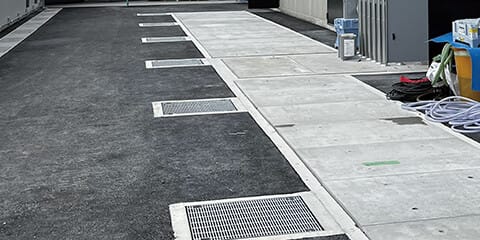
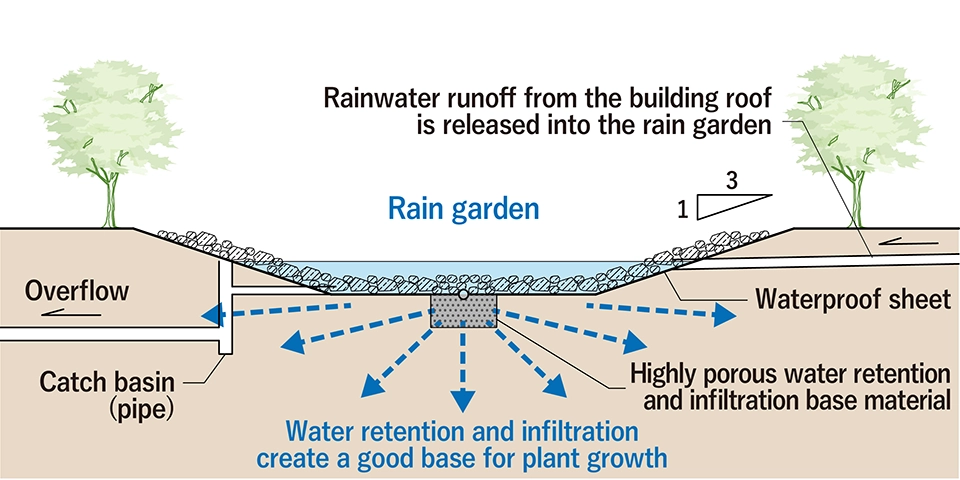
Rain gardens temporarily retain rainwater runoff and let it slowly soak into the ground beneath. It benefits the growth of plants and functions to gradually improve the soil of reclaimed land. The technology has been spotlighted as green infrastructure in recent years, because rain gardens also serve to prevent rainwater from running off the premises. A mockup was created prior to construction to verify the aggregate size and density in the infiltration base material that would offer the appropriate water retention and infiltration volume.
Note: This page reflects information as of July 2024.